
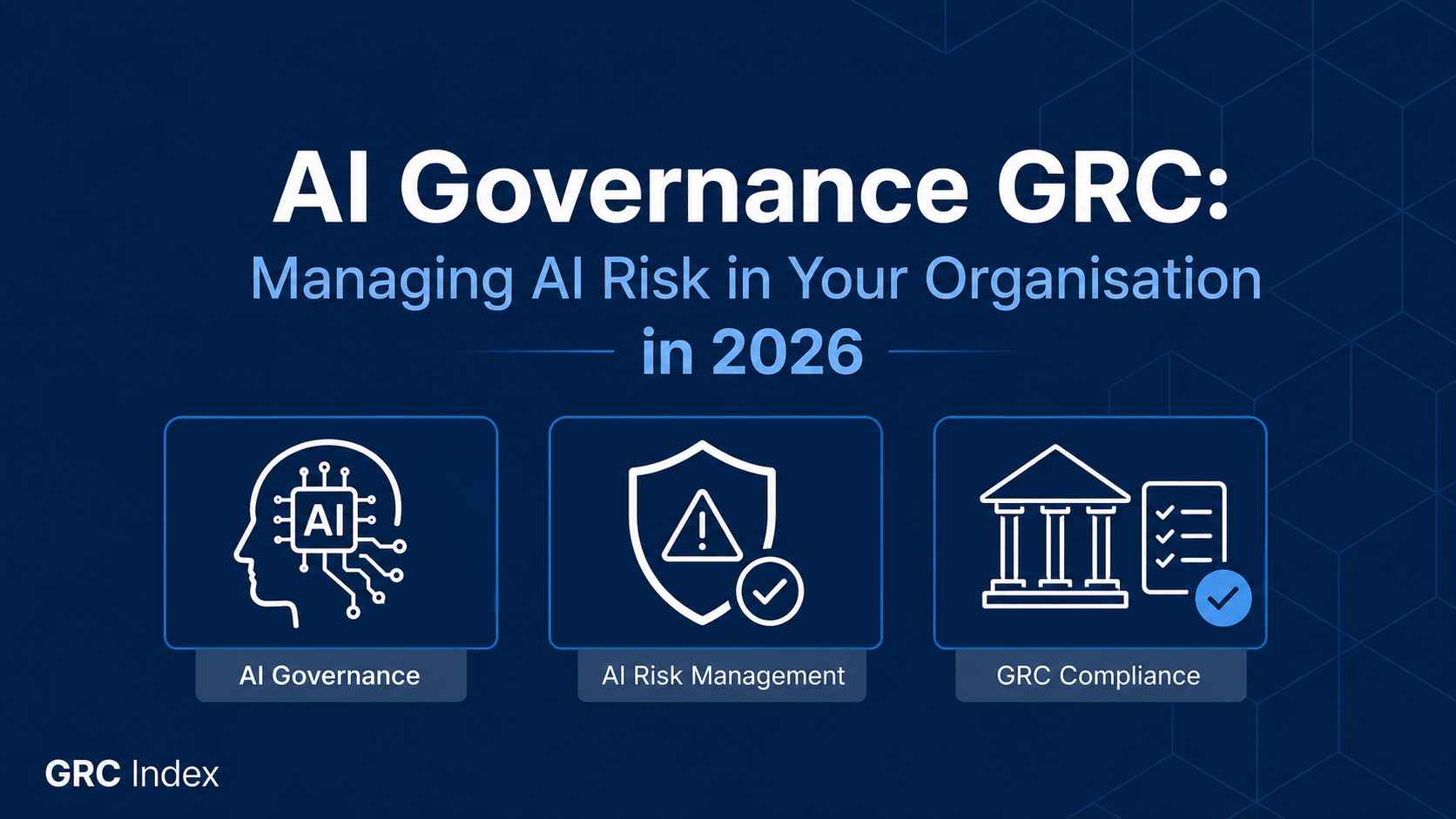
AI governance and GRC are converging. Organisations deploying AI systems without formal governance structures face growing regulatory, legal, and reputational exposure.
AI governance GRC is the integration of AI risk management into your governance, risk, and compliance programme. It means treating AI systems as accountable assets with documented controls, human oversight, and board-level reporting.
In 2026, this is no longer optional. The EU AI Act is in active enforcement. ISO/IEC 42001 provides a certifiable AI management system standard. UK financial regulators have published clear expectations on AI risk. Boards need a structured response.
This guide covers what AI governance is, why boards must treat it as a formal risk category, the key frameworks, and how to integrate AI into your GRC programme.
AI Governance GRC: Key Facts for 2026
EU AI Act:
High-risk AI provisions in force from August 2026
ISO/IEC 42001:
First international AI Management System standard (Dec 2023)
UK approach:
Pro-innovation sector regulators (FCA, ICO, CMA) apply existing law
FCA/PRA:
Published AI governance expectations for financial services firms
DORA:
Algorithmic models included in ICT risk management obligations
Fines (EU AI Act):
Up to 35,000,000 EUR or 7% of global annual turnover for prohibited AI
What Is AI Governance?
AI governance is the set of policies, processes, and controls that determine how an organisation builds, deploys, monitors, and retires artificial intelligence systems.
It covers who is accountable for AI decisions, how AI risk is identified and managed, and what safeguards exist when AI systems affect people or regulated processes. It is not the same as IT governance, though they overlap.
AI systems introduce risks that general IT controls do not fully address. These include model hallucination, algorithmic bias, explainability gaps, and uncontrolled model drift over time. A governance framework sets the rules for managing all of them.
What an AI Governance Framework Includes
- AI inventory: a documented register of all AI systems in use, including third-party tools
- Risk classification: categorisation of each AI system by risk level and regulatory obligation
- Accountability structures: named individuals responsible for each AI system's performance and compliance
- Human oversight mechanisms: controls ensuring humans can review, override, or halt AI decisions
- Monitoring and audit processes: ongoing testing of AI systems for accuracy, bias, and drift
- Incident response: defined procedures for AI system failures, unexpected outputs, or regulatory triggers
- Data governance: controls for AI training data quality, provenance, and access
Why Boards Must Treat AI as a Formal Risk Category
AI risk is a board-level issue in 2026. Regulatory obligations, personal liability, and stakeholder scrutiny have all increased. Boards that treat AI as purely an IT or innovation matter are exposed.
The EU AI Act imposes fines of up to 35,000,000 EUR or 7 per cent of global annual turnover for prohibited AI use. Even limited-risk AI systems require transparency disclosures. High-risk AI systems, those used in employment, credit, essential services, or law enforcement, carry full conformity obligations.
UK financial regulators are equally focused. The FCA and PRA have both published discussion papers on AI risk in financial services. They expect firms to apply the same model governance discipline to AI systems that they apply to algorithmic trading and credit scoring models.
Why AI Risk Belongs on the Board Agenda
Regulatory fines:
EU AI Act penalties apply to UK organisations serving EU users
Personal liability:
FCA SMCR Senior Managers are accountable for AI systems in their remit
Provision 29:
AI governance controls are material controls under UK Corporate Governance
DORA:
Algorithmic models and automated systems are within ICT risk scope
Procurement risk:
Enterprise clients increasingly require AI governance evidence
Reputational risk:
AI incidents, bias, hallucination, data exposure, attract regulatory scrutiny
AI Governance Frameworks: EU AI Act and ISO/IEC 42001
Two frameworks define AI governance obligations for UK and EU organisations in 2026. The EU AI Act provides the regulatory baseline. ISO/IEC 42001 provides the management system standard.
EU AI Act (Regulation EU 2024/1689)
The EU AI Act is the world's first comprehensive AI regulation. It entered into force in August 2024. Its provisions apply in phases through to August 2027. High-risk AI system obligations apply from August 2026.
The Act takes a risk-based approach. AI systems are classified into four tiers based on the risk they pose to health, safety, and fundamental rights.
- Prohibited AI: systems that pose unacceptable risk. Includes social scoring by public authorities and real-time remote biometric surveillance in public spaces. Banned from February 2025.
- High-risk AI: systems that affect access to employment, education, essential services, credit, law enforcement, or critical infrastructure. Full conformity obligations from August 2026.
- Limited risk: AI systems with transparency obligations only. Chatbots must disclose that users are interacting with an AI. Deepfakes must be labelled.
- Minimal risk: AI systems with no specific obligations under the Act. Spam filters and game AI fall here.
The EU AI Act applies to any organisation placing AI systems on the EU market or putting them into service in the EU. UK-based organisations offering AI-powered products to EU users are within scope.
EU AI Act Enforcement Timeline
August 2024:
Act entered into force
February 2025:
Prohibited AI provisions apply (Chapter II)
August 2025:
General Purpose AI (GPAI) model obligations apply
August 2026:
High-risk AI system obligations apply (Chapter III and IV)
August 2027:
Remaining provisions for Annex I and II AI systems
ISO/IEC 42001: AI Management System Standard
ISO/IEC 42001 was published in December 2023. It is the first international standard for AI management systems. Organisations can pursue formal certification against it, just as they certify against ISO 27001 for information security.
The standard covers AI strategy and objectives, risk assessment for AI systems, data governance for AI training and operation, performance monitoring and transparency, and responsible AI design principles. It is structured to integrate with ISO 27001, ISO 9001, and ISO 31000.
For UK organisations, ISO/IEC 42001 provides a structured path to demonstrable AI governance. Certification can be used as evidence in procurement, regulatory reviews, and client due diligence processes.
UK AI Policy
The UK has not enacted a standalone AI Act. The government's approach relies on sector regulators applying existing law to AI. The FCA, ICO, CMA, and Ofcom each have published or are developing AI guidance for their sectors.
The UK AI Security Institute conducts safety evaluations of frontier AI models. UK organisations subject to GDPR, the Equality Act, and product liability law face existing obligations when AI systems affect individuals.
AI Risk Management Best Practices for UK Organisations
Managing AI risk requires a structured approach. The ten practices below apply whether your organisation builds AI internally, uses third-party AI tools, or both.
- Build an AI inventory : Document every AI system in use across your organisation. Include third-party tools, embedded AI in software platforms, and any internally developed models. Without an inventory, you cannot assess or govern AI risk.
- Classify AI systems by risk tier : Map each AI system to the EU AI Act risk classification. High-risk systems require immediate priority. Even limited-risk systems need documented transparency controls. Classification informs your governance priority order.
- Implement an AI governance policy : Publish a formal AI governance policy approved at board or senior management level. It should cover permitted use cases, prohibited uses, accountability structures, and the review process for new AI deployments.
- Establish human oversight mechanisms : For any AI system affecting consequential decisions, define how humans can review, question, or override the AI output. Document these mechanisms. Regulators and auditors will ask for evidence they exist and operate.
- Add AI to your risk register : Create AI-specific risk categories in your risk register. Include model failure risk, data quality risk, regulatory non-compliance risk, and vendor AI risk. Review these at every risk cycle.
- Assess AI vendor risk : Most organisations use AI embedded in third-party software. Include AI governance questions in your vendor risk assessment process. Ask vendors about their model governance, data handling, and EU AI Act compliance status.
- Monitor AI systems continuously : AI systems change over time through retraining, updates, and data drift. Set performance monitoring thresholds and review triggers. Document monitoring results as evidence for auditors and regulators.
- Train staff on AI use policies : Employees using AI tools for business tasks carry risk. Provide clear training on acceptable use, prohibited actions, and incident reporting. Maintain training records as evidence of your governance programme.
AI Risk Management Checklist for UK Organisations
AI inventory completed and maintained
Each system classified against EU AI Act risk tiers
AI governance policy approved and published
Human oversight mechanisms documented for high-risk AI
AI risk categories in the risk register
Vendor AI risk assessments completed
Continuous model monitoring in place with documented reviews
Staff AI use training with records
AI incident response process defined
AI governance included in board risk reporting
Integrating AI Governance into Your GRC Programme
AI governance is not a separate workstream. It belongs within your existing GRC structure. Organisations that treat AI governance as a standalone IT project typically end up with documentation that sits outside the main compliance framework and is never reviewed in the risk cycle.
Integration starts with the risk register. AI should be a defined risk category with sub-categories for model risk, data risk, regulatory risk, and third-party AI risk. Each entry should have a named owner, a current risk rating, and linked controls.
AI risk maps directly to existing GRC domains. You do not need a new framework to govern it. You need to extend your current one.
- Governance and Oversight domain: add AI governance policy ownership and board accountability for AI to existing governance structures
- Risk Management domain: include AI risks in every risk identification, assessment, and mitigation cycle
- Regulatory Compliance domain: map EU AI Act obligations, ISO/IEC 42001, and FCA/ICO AI guidance to compliance controls
- Information Security domain: extend security controls to cover AI model integrity, training data security, and AI system access
- Third-Party Risk domain: add AI-specific questions to vendor risk assessments; confirm AI governance of critical AI tool suppliers
- Operational Resilience domain: include AI system failure in business continuity and incident response planning
The three lines of defence model applies directly to AI. The business owns AI risk and operates the controls. Compliance provides oversight and governance. Internal audit tests the controls independently.
How GRC Assessment Covers AI Risk
A GRC assessment that does not address AI risk is incomplete. AI systems are now embedded in operations, customer interactions, and compliance processes at most organisations. Excluding them from GRC assessment leaves significant blind spots.
The GRC Index benchmark assesses AI governance risk within the existing domain structure. Organisations that complete a GRC Index benchmark receive a scored view of how well their current GRC programme addresses AI risk alongside all other control domains.
- Governance and Oversight: the assessment evaluates whether AI governance policies exist and whether board accountability for AI is documented
- Risk Management: the assessment checks whether AI risk categories appear in the risk register and are reviewed at appropriate intervals
- Information Security: the assessment covers AI system security controls, data access governance, and model integrity monitoring
- Third-Party Risk: the assessment evaluates whether vendor AI risk assessments are performed and whether AI model provenance is documented
Organisations at maturity Level 1 to 2 in these domains typically have no formal AI governance at all. The GRC Index score identifies the specific gaps and prioritises remediation. From Level 3 upward, structured AI governance is both achievable and evidenced.
Start with Your GRC Index Benchmark
Before building an AI governance programme, measure where you are today.
A GRC Index benchmark gives you:
Scored maturity across six GRC domains (0-100 per domain)
RAG status per domain with priority action list
Evidence of AI governance gaps for Provision 29 and DORA
Board-ready reporting on GRC performance
A public GRC profile demonstrating governance commitment
Book your GRC Index benchmark at grci.net
Frequently Asked Questions
What is AI governance in the context of GRC?
AI governance in GRC refers to the policies, processes, and controls that manage how an organisation develops, deploys, and monitors AI systems. It addresses who is accountable for AI decisions, how AI risk is identified and assessed, and how AI systems are audited. AI governance sits within the Governance and Oversight and Risk Management domains of a GRC framework, and extends into Information Security and Third-Party Risk.
How should UK organisations manage AI as a risk category?
UK organisations should start by building an AI inventory covering all systems in use. Each system should be classified by risk level aligned to the EU AI Act tiers. AI risk should be added to the organisational risk register with named owners and reviewed at every risk cycle. Human oversight mechanisms must be documented. Vendor AI risk assessments are required for all third-party AI tools. Staff training records demonstrate that AI use policies are being applied.
What frameworks exist for AI governance?
The primary frameworks are the EU AI Act (Regulation EU 2024/1689), which applies a risk-based approach to AI regulation with high-risk provisions applying from August 2026, and ISO/IEC 42001, the first international AI Management System standard published in December 2023. In the UK, sector regulators including the FCA, ICO, and CMA apply existing law to AI, and organisations should monitor sector-specific guidance from each relevant regulator.
Does the EU AI Act affect UK organisations?
Yes. The EU AI Act applies to any organisation placing AI systems on the EU market or deploying them for EU users, regardless of where the organisation is headquartered. UK companies offering AI-powered products or services to EU customers or operating in the EU must comply with EU AI Act requirements. High-risk AI provisions apply from August 2026. Non-compliance risks fines of up to 35,000,000 EUR or 7 per cent of global annual turnover.
How does AI governance fit into a GRC assessment?
AI governance is assessed within the existing GRC domain structure rather than as a standalone assessment. Governance and Oversight covers AI policy ownership and board accountability. Risk Management covers AI risk register entries and assessment processes. Information Security covers AI system security controls and data access governance. Third-Party Risk covers vendor AI due diligence and model provenance. A GRC Index benchmark scores all six domains and identifies where AI governance gaps exist.