
No single European law requires GRC. A mix of EU laws and national rules sets your duties. Each country then adds its own regulator, its own dates, and its own terms.
Five EU laws form the base of European GRC. The five are: GDPR, NIS2, DORA, the AI Act and the Cyber Resilience Act. Each country adds its own regulator and its own rules. The UK stays outside the EU but runs parallel rules of its own.
For example: You may run one office in Dublin, Ireland, and another in Munich, Germany. Which rules apply to each of them? The answer changes by country. The law also moves fast. A NIS2 law is now in force in 24 of 27 EU states. France, Ireland and Spain still have none.
What does GRC mean for a European organisation?
GRC stands for governance, risk and compliance. Governance sets who decides and who answers for the result. Risk management finds what could go wrong and ranks it by impact. Compliance proves that you meet the rules that apply to you. In this article, we use GRC in the business sense. It has no link to the Gender Recognition Certificate, which shares the same letters. Search results for the term often mix the two.
GRC work in Europe rests on two kinds of rules. Laws bind you by force of the state. Standards such as ISO 27001, SOC 2 and the COSO framework bind you through contracts and customer demands. A cloud provider in the Netherlands usually faces NIS2 as a legal duty. Its customers may also ask for an ISAE 3402 report as proof of control.
Which five EU laws form the base of every country's rules?
These are the five main EU laws that almost all European Governance, Risk, and Compliance (GRC) programmes depend on. These are GDPR, NIS2, DORA, the EU AI Act, and the Cyber Resilience Act (CRA).
These frameworks have requirements that overlap for things like risk assessments, supply chain security, and reporting incidents. Because of this, modern European GRC programs use a single set of internal controls to cover all five laws instead of managing them separately.
The AI Act dates changed in 2026. EU lawmakers adopted a delay to the high-risk rules in mid-2026. Older articles that show 2 August 2026 are therefore out of date.
Why does one EU law look different at every border?
An EU law reaches you through a chain. The EU text comes first. Each state then adds its own law, its own regulator and its own forms. Your controls must answer all of them.
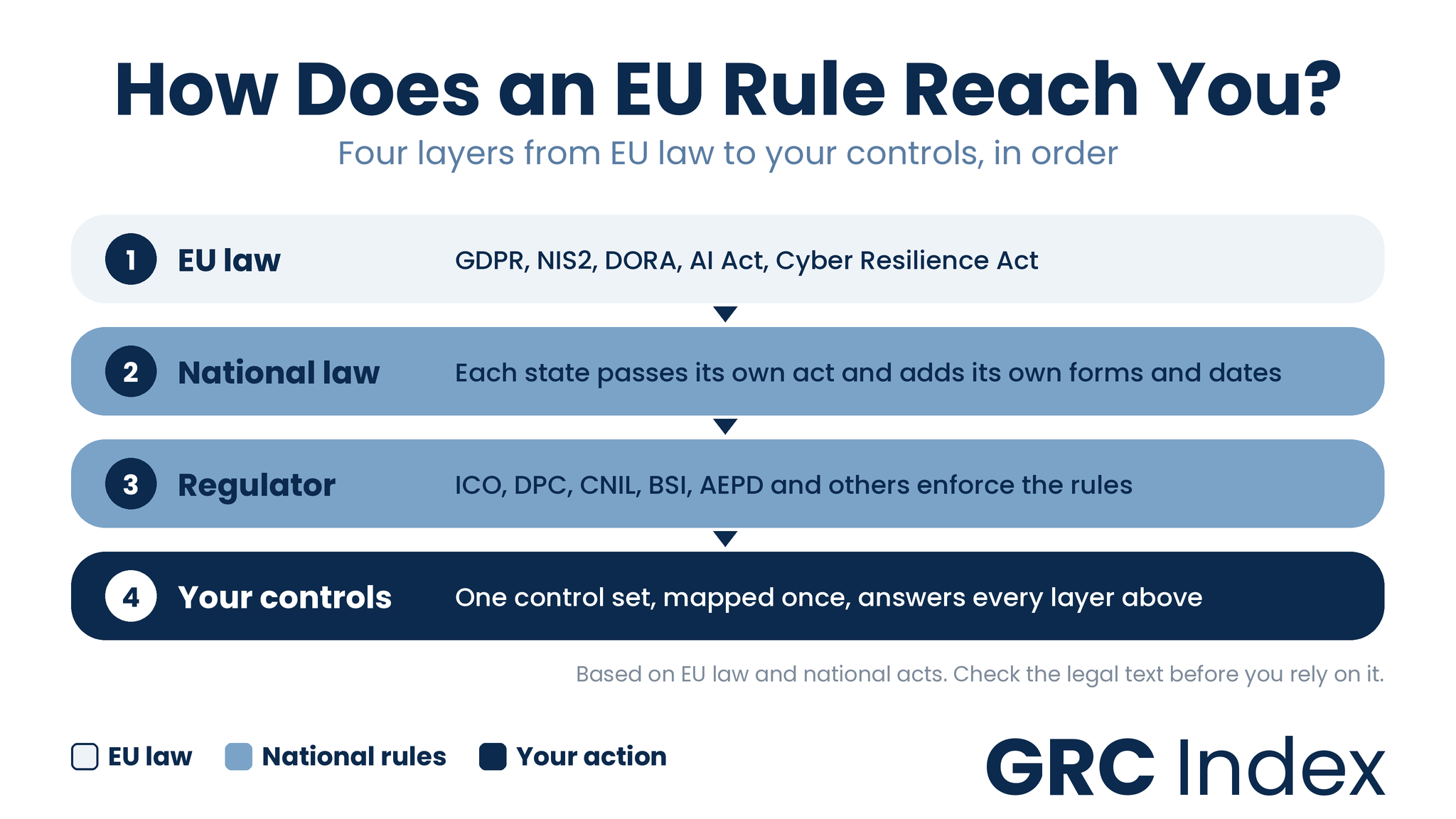
The controls sit at the end of the chain. They must answer every layer above. A group with entities in Belgium, the Netherlands and Germany shows the problem. Each entity follows the law of the state where it is established. The group therefore applies three national laws, registers on three portals and reports to three authorities. If personal data is involved, a GDPR breach notice adds one more report.
GDPR does ease part of the load. A lead regulator, usually in the country of the main establishment, coordinates cross-border cases. Local duties still stand, however. National employment rules and sector regulators in each country keep their force.
How far has each country travelled with NIS2?
NIS2 shows the gap between states better than any other law. The EU deadline passed on 17 October 2024. A national law is now in force in 24 of 27 states. France, Ireland and Spain have none. The Commission referred Ireland, Spain, France and the Netherlands to the Court of Justice on 8 July 2026. The Netherlands then put its law into force on 15 August 2026. A referral can lead to fines for the state, not for companies. Almost every country in the bloc has passed laws, but they are all at quite different stages of putting them into effect.
You can check which row matches your office locations. The UK has no NIS2 law. It follows its own path, which the next section covers.
What must you meet in each of the main markets?
Seven markets matter most to UK and European organisations. Which of them hold your customers?
What does the UK expect from you?
The UK left the EU. Its rules still follow the EU pattern closely. UK GDPR and the Data Protection Act 2018 govern personal data. The ICO enforces them.
The Data (Use and Access) Act 2025 changed parts of that regime. Its main data protection changes took effect on 5 February 2026. The EU renewed its adequacy decision for the UK on 19 December 2025. Personal data can therefore still move from the EU to the UK until 27 December 2031.
Cyber duties sit in the NIS Regulations 2018. The Cyber Security or Resilience Bill will update them. It increases the scope to include data centers and managed service providers. It also adds 24-hour and 72-hour incident reports and maximum fines of £10 million or 2% of global turnover. The Bill has passed the Commons and now sits in the House of Lords. It has no Royal Assent yet. Expert sources differ on the date. Financial firms also answer to the FCA and the PRA on operational resilience.
What does Ireland expect from you?
The Data Protection Commission enforces GDPR and the Data Protection Act 2018. Many large technology firms keep their EU headquarters in Ireland like Meta (facebook), Apple and Microsoft. The DPC therefore leads many cross-border cases. The Central Bank of Ireland supervises financial firms under DORA. Ireland has no NIS2 law. Only a General Scheme of the National Cyber Security Bill exists. The older NIS rules still apply to essential operators. A Court referral in July 2026 adds pressure to pass the law.
What does Germany expect from you?
The Federal Data Protection Act (BDSG) supplements GDPR. Sixteen state authorities supervise most private firms, next to the federal commissioner. BaFin supervises financial firms under DORA. Germany passed its NIS2 act (NIS2UmsuCG), which took effect on 6 December 2025. The BSI runs the registration portal. Entities already in scope had to register by 6 March 2026. New entrants register within three months after they fall into scope. Service providers can prove their controls to German customers with an ISAE 3402 report or an IDW PS 951 report.
What does France expect from you?
The CNIL enforces GDPR. ANSSI leads on cybersecurity. The ACPR and the AMF supervise financial firms. France has no NIS2 law. The Senate adopted the bill on 12 March 2025. The National Assembly took it off the agenda on 6 October 2026 and listed it again from 9 November 2026. ANSSI offers voluntary pre-registration on MonEspaceNIS2. French rules also reach beyond cyber. The Sapin II law requires large companies to run anti-corruption compliance programmes.
What does Spain expect from you?
The AEPD enforces GDPR. The Bank of Spain, the CNMV and the DGSFP supervise financial firms. The National Security Scheme (ENS) already binds public bodies and their suppliers. Spain has no NIS2 law. The draft Law on Cybersecurity Coordination and Governance never reached Parliament. The Cortes were dissolved on 6 October 2026 before a general election on 29 November 2026. A new law cannot move before the new Cortes meet on 23 December 2026.
What do the Netherlands and Sweden expect from you?
The Dutch Data Protection Authority (Autoriteit Persoonsgegevens) enforces the GDPR. The Cyberbeveiligingswet took effect on 15 August 2026. Registration in the NCSC register became mandatory from that date. DNB and the AFM supervise financial firms.
Sweden's Cybersecurity Act (2025:1506) took effect on 15 January 2026. IMY enforces GDPR. Finansinspektionen supervises financial firms. You should also check Dutch and Swedish sites they cover ISAE 3402 for local buyers.
Which regulators watch you in the rest of Europe?
Other markets follow the same pattern. The table names the main regulators. You should confirm each name on the regulator's own site before you act.
Do EU rules follow you outside the EU?
Often they do. GDPR reaches any organisation that handles the personal data of people in the EU or EEA, wherever that organisation sits.
- A UK firm with EU customers therefore meets GDPR as well as UK GDPR. The adequacy decision only eases the transfer of data between the two.
- Norway applies GDPR through the EEA Agreement. Other EU acts, such as NIS2 and DORA, apply only once they enter the EEA Agreement and Norwegian law.
- Switzerland runs its own data protection act, which has applied since 1 September 2023. Swiss operators of critical infrastructure have had to report cyberattacks within 24 hours since 1 April 2025.
DORA reaches suppliers too. An ICT supplier outside the EU that serves EU banks or insurers feels DORA through its customers' contracts.
How can one set of controls answer many laws?
You do not need five separate programmes. One control often satisfies several rules. Access management shows the point clearly. It supports GDPR Article 32 on data security, NIS2 Article 21 on cyber risk measures, DORA's ICT risk rules, and ISO 27001.
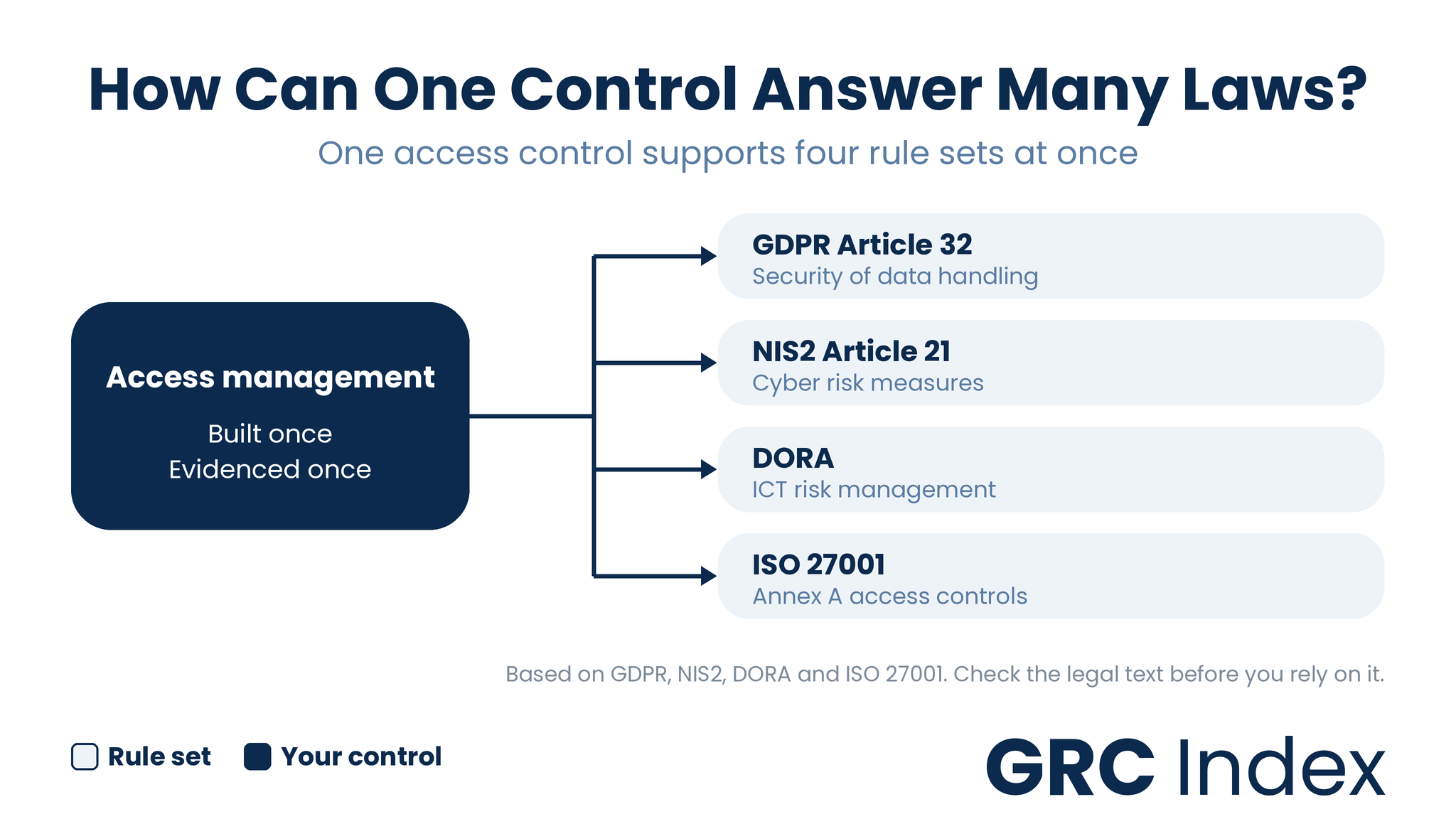
A single access control supports four rule sets at once.
You build the control once. You collect the evidence once. You then show coverage against each law and standard. Auditors and customers also ask for proof that a third party tested the controls.
Where does your organisation stand today?
Rules tell you what to meet. A score tells you how far you have come. GRC Index gives UK and European organisations a free way to measure that distance. More than 1,300+ organisations already sit in the index.
You start with a self-assessment. It takes about nine minutes and covers 14 frameworks, such as ISO 27001, SOC 2 and COSO. The score begins at 10. A verified score follows an evidence review and lands between 45 and 55.
Extra points then follow. Qualified staff adds 10 points, extra certification types add 5 and completed courses add 25. A score of 95 or more needs verified yearly courses. A self-assessment alone is not independent verification.
The index gives you five things.
- A free first score in about nine minutes
- One scale across 14 frameworks
- A public index entry that buyers and partners can find
- A clear path from self-assessment to a verified score
- Free registration for your organisation and your website
You can register your organisation and list your business on GRC Index without any cost. Grc index offer Traning and certification courses can lift your score as well.
Are Ready to see your score? You can start the free self-assessment and add your organisation to the index.
How do you start in your first 30 days?
You can finish a solid first pass in one month. The steps run in order. Each one feeds the next.
- You list every legal entity, its country and its sector in week one.
- You match laws to each entity with the tables above in weeks one and two.
- You name the regulator for each entity and note its deadlines in week two. The common ones are 72 hours for a GDPR breach notice and 24 hours, 72 hours and one month for NIS2 reports.
- You run a baseline self-assessment in week three.
- You fix the largest gaps in week four and give each one an owner and a date.
You should start with the entity that faces the nearest deadline or the most active regulator.
What dates should you mark on the calendar?
Several dates ahead matter to your plans. Most hard EU deadlines fall in 2027 and 2028. The Spanish election comes first.
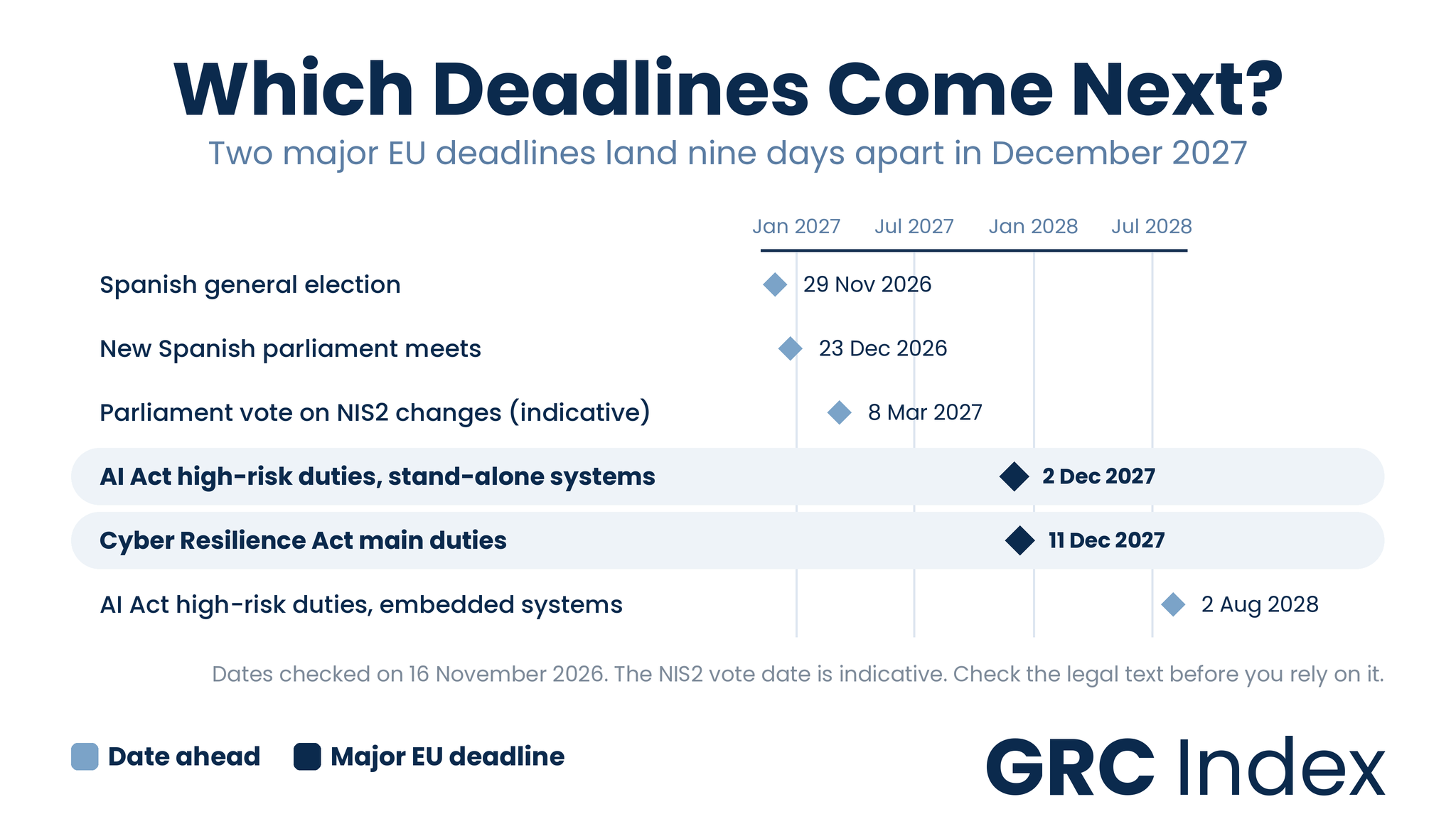
Spain votes first. The AI Act and Cyber Resilience Act deadlines follow in December 2027.
The UK Cyber Security and Resilience Bill has no fixed date yet. The French and Irish bills have none either. The Commission also proposed a targeted NIS2 amendment in January 2026. Parliament has not yet voted on it.
The EU also negotiates GDPR changes in its Digital Omnibus. The Council agreed its position in October 2026. Parliament has not yet set its own. The current GDPR text therefore still applies.
Frequently asked questions
Is GRC a legal requirement in Europe?
(GRC) is not a single mandated software tool or standalone legal requirement in Europe; however, the functions of governance, risk management, and compliance are legally required under key European Union regulations.
Does NIS2 apply in the UK?
NIS2 Directive doesn't directly affect businesses that only operate in the UK.
Which EU states have no NIS2 law in force?
France, Ireland and Spain had none in early November 2026. The other 24 states have a law in force.
Does DORA apply to UK firms?
DORA applies directly to financial entities in the EU. A UK firm feels it through its EU entities or through contracts with EU financial customers.
What is GRC software?
Governance, Risk, and Compliance software (GRC) refers to a centralised digital platform that is utilised by organisations for the purpose of managing corporate policies, monitoring and mitigating business risks, and demonstrating compliance with industry or government standards.