
Yes, GRC certification can help you win enterprise contracts. Buyers rarely ask for a "GRC certificate" by that name, though. They ask for named proof such as Cyber Essentials, ISO 27001 or SOC 2. Your proof must match the buyer's check. In this guide, we will explain what UK buyers ask for, when they ask and what it costs. It also shows where a certificate doesn't help.
What does "GRC certification" mean to a buyer?
Buyers use the phrase "GRC certification" in three ways. The first is a personal credential for one person, such as CRISC or CGRC. The second is a company standard, such as ISO 27001 or Cyber Essentials. The third is an active GRC programme that joins governance, risk and compliance into one set of policies and controls.
Enterprise buyers care most about the second and third meanings. A personal credential shows that one person has skill. It does not certify your organisation. Our guide to GRC certification and ISO 27001 covers that all in detail.
Do enterprise buyers really ask for it?
Yes, and many ask early. Public buyers state the need in the tender notice. Private buyers send a security questionnaire. Both ask for evidence before they sign.
UK government gives the clearest rule. Procurement Policy Note 014 replaced PPN 09/14 and PPN 09/23 for procurements that started on or after 24 February 2025. It applies to central government departments, their agencies and NHS bodies.
Those buyers must make sure suppliers show suitable technical controls on higher-risk contracts. Cyber Essentials or Cyber Essentials Plus is the main route to show them.
Private buyers follow a similar path. More than 230 organisations have signed the government's Cyber Resilience Pledge. Signatories apply a risk-based approach to their requests for Cyber Essentials across their supply chains.
Not every buyer checks, though. The Cyber Security Breaches Survey 2025/26 found that 15% of UK businesses review the cyber risks of their immediate suppliers. The share rises with size. It runs from 12% among micro businesses to 48% among large ones.
Enterprise buyers sit at the top of that range, so they are most likely to ask. Large firms hold the proof themselves. Some 35% of them hold Cyber Essentials, against 5% of all businesses. Firms interviewed for the survey also named procurement and client demands among their reasons to get it.
Which certificates do buyers ask for?
Usually, buyers ask for five types of proof most often. The Cyber Essentials, ISO 27001, Cyber Essentials Plus, ISAE 3402, and SOC 2.
SOC 2 and ISAE 3402 suit firms that run services for clients. The AICPA Trust Services Criteria cover security and four related areas, such as privacy and confidentiality. ISAE 3402 suits those who are service providers whose processes, such as payroll, feed into a client's accounts.
ISO 27001 does not replace Cyber Essentials on a government tender. ISO 27001 report does not automatically meet Cyber Essentials. The five technical controls are not normally in its scope. You can see the comparison of Cyber Essentials vs ISO 27001 we wrote in detail.
How does certification help at each stage of a bid?
Proof matters at six points in a public-sector bid. In this diagram that follows them in order.
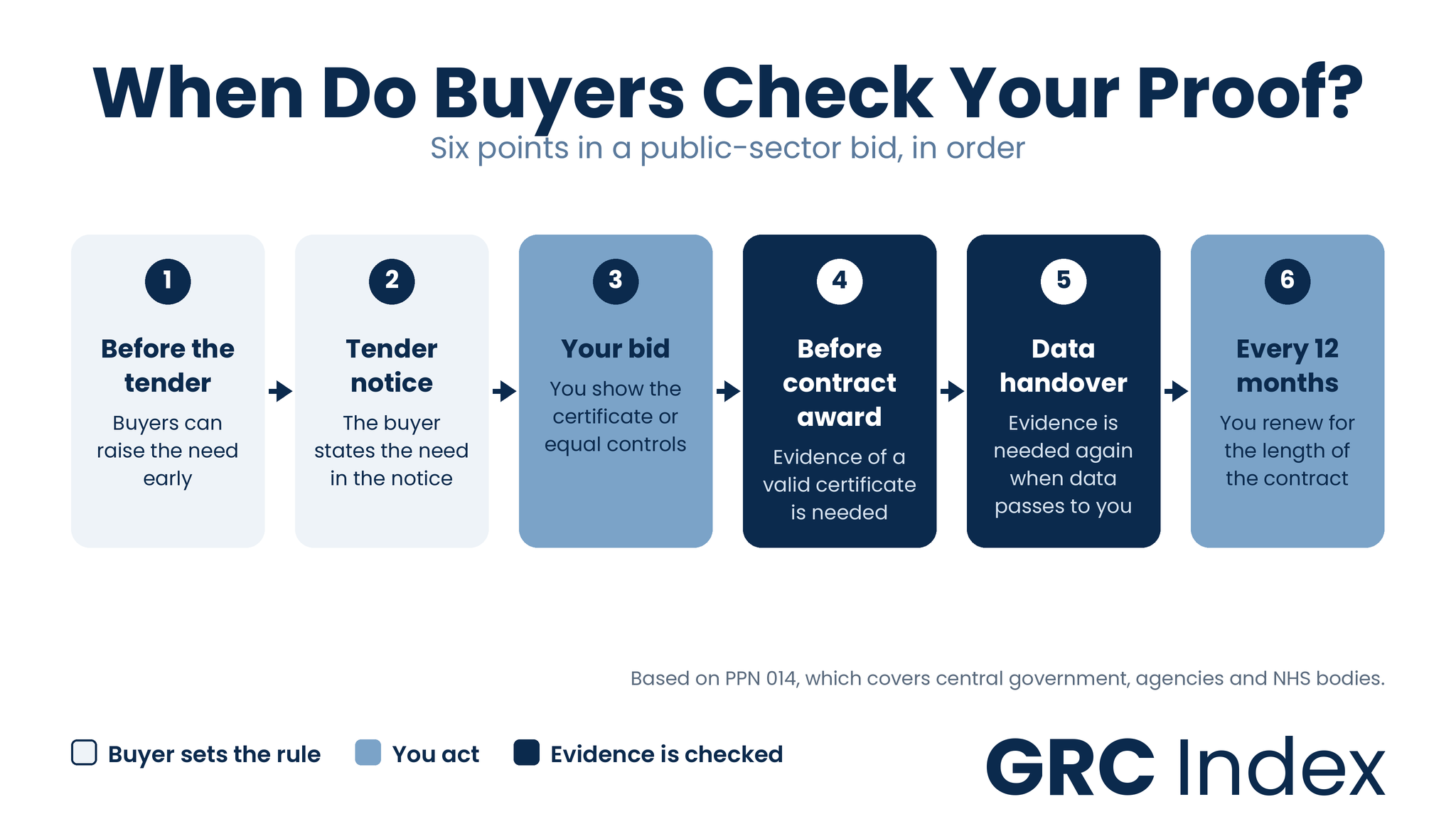
For Instance, a 40-person firm that supplies payroll software to a government department handles the personal data of civil servants. The contract meets the data test in the PPN. The buyer names Cyber Essentials in the tender notice. The firm shows its certificate with the bid and again before award.
PPN 014 tells government buyers to state the need in the tender notice, so you can see it early. Evidence of a valid certificate is needed before contract award. It is needed again when data passes to you. A lapsed certificate breaks the rule because Cyber Essentials must be renewed every year for the length of the contract.
Private buyers follow a similar path. They send a security questionnaire and hold a due diligence call. Your proof answers many of those questions in advance.
What does certification do for your win rate?
Certification helps in six ways. Each one links to a point in the bid.
Will it get you past the first check?
A tender may name Cyber Essentials as a pass or fail item. A supplier who has no proof may not move on. The PPN asks for evidence before contract award. A gap at that point puts the award at risk.
Will it speed up security reviews?
Proof answers many questions before the buyer asks them. A 30-person software firm, for instance, may have ten enterprise prospects at once. Each prospect sends its own questionnaire. One certificate and one short answer pack cut the repeat work.
Will it build trust with procurement teams?
Procurement and risk teams need solid proof they can file. A certificate from an independent body gives them that proof. Cyber Essentials Plus goes a step further. An assessor tests a sample of your systems, typically around 10%, against the same five controls.
Will it open public sector and regulated work?
PPN 014 applies to central government departments, agencies and NHS bodies. Other public bodies may choose to apply the same approach. Regulated buyers in finance and health often ask for ISO 27001 instead. The right certificate lets you meet the rule before the tender opens.
Will it improve risk control behind the scenes?
The audit work lowers your own risk. Cyber Essentials covers five areas, namely firewalls, secure configuration, user access control, malware protection and security update management. ISO 27001 goes wider and asks you to assess and treat the risks you find. Government also notes that certified firms with a turnover under £20 million receive up to £25,000 of cyber liability insurance.
Will it help your team answer buyers in one voice?
A GRC programme gives sales, IT and legal one set of facts. Everyone quotes the same scope, the same dates and the same controls. Answers are no longer different from person to person. A free GRC assessment shows where your governance, risk and compliance stand today.
When does certification not help?
A certificate is not a promise of a win. It has limits. You must know them before you pay.
- PPN 014 tells government buyers not to ask for Cyber Essentials on every contract
- Buyers must accept equal controls, so a certificate is one route and not the only route
- The scheme does not assure a specific product or service
- A certificate covers one legal entity by default, so a sister company may sit outside it
- Cyber Essentials does not stop advanced, targeted attacks
- A certificate proves your controls at one point in time, so gaps can open before the year ends
- The wrong badge wastes money, because ISO 27001 does not automatically meet a Cyber Essentials tender rule
The PPN gives clear examples. A contract for contact centre services that holds citizens' names, addresses and National Insurance numbers meets the data test. A sole trader who teaches ten people to drive, with very little use of IT, does not.
You should match the badge to the buyer first. Then you should pay for it.
How much does it cost and how long does it take?
There are 4 type of assessment’s Micro, Small, Medium, and large and the cost depdnding on the type. Cyber Essentials costs hundreds of pounds. ISO 27001 costs more and takes months. Fixes to weak settings or old devices cost extra. The table gives the figures that the certification bodies publish.
The Plus audit is quoted for each firm. The government cut the cost for smaller firms on 3 November 2026. The Cyber Essentials First Step Fund gives eligible micro, small and medium businesses 75% off a new certification. Eligible firms pay between £80 to £125 plus VAT. You should check your eligibility before you apply.
The offer is first come, first served. It runs until March 2027, or until the £2.4 million fund runs out. Firms certified in the last four years do not qualify. A separate grant, worth up to £7 million until March 2029, can fully fund first-time certification for SME suppliers that a Cyber Resilience Pledge signatory nominates.
Which certificate should you get first?
First, you should get Cyber Essentials instead of ISO 27001. It would be good for small or medium firms, specifically in the UK.
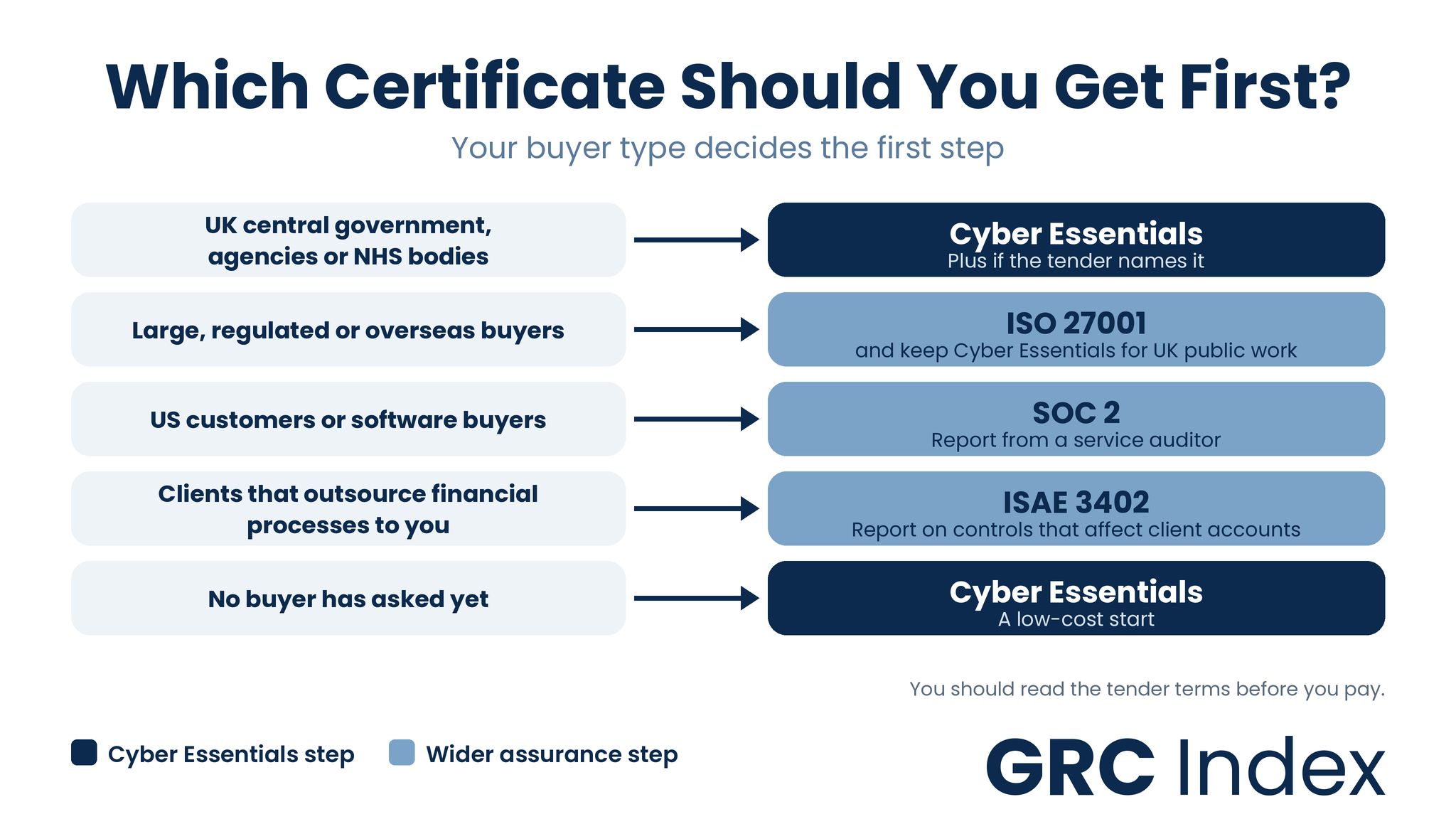
On the other hand if for large firm, regulated or overseas buyers ISO 27001 is the good option.
How do you show your certificate to buyers?
A certificate helps only when buyers can check it. You should put the certificate number, the issue date and the scope in every tender answer. PPN 014 says Cyber Essentials covers the supplier's legal entity by default. Buyers are told to check the scope, so you should state the legal entity and the scope clearly.
IASME removes a company from its certified list when the certificate is more than a year old. IASME emails a reminder about a month before renewal, but you should keep your own diary entry too. Buyers can check an ISO 27001 certificate on the UKAS CertCheck database.
You should also keep one answer pack. It holds the certificate, the scope statement, a short policy summary and the date of your last review.
A public GRC Index entry can add one more reference point for buyers. It does not replace a certificate. An initial self-assessment is not independent verification.
FAQs
Is Cyber Essentials mandatory for UK government contracts?
Cyber Essentials is not mandatory for all UK government contracts, but many central government, defense, and public sector contracts are because of the amount of risk and data they handle.
Does ISO 27001 replace Cyber Essentials?
No, ISO 27001 is not a replacement for Cyber Essentials.
The two frameworks share about 60% of their technical controls, like the patch management and access control found in ISO 27001 Annex A. However, they are used for different things and are judged by different systems.
Do UK buyers accept SOC 2?
Most business and government buyers in the UK don't ask for SOC 2 by name; instead, they prefer ISO 27001 for businesses and Cyber Essentials for government contracts. However, some large multinational or tech-focused UK companies will accept a SOC 2 Type 2 report.
Does Cyber Essentials Plus carry more weight than Cyber Essentials?
Yes, Cyber Essentials Plus is far more valuable than the basic Cyber Essentials.
How long does a certificate last?
Cyber Essentials and Cyber Essentials Plus certificates expire after 12 months. An ISO 27001 certificate lasts three years, with yearly surveillance audits.
Can a small firm win enterprise work without certification?
Yes, a small company can get work from big companies even if they don't have official licenses. But the talk needs to change from compliance to risk management and proof of capability. Large businesses and companies in the Fortune 500 use certifications like ISO 27001, SOC 2, or badges specific to their industry as a quick way to make sure that a vendor won't pose any legal, operational risks or security.
If you don't have these badges, you need to show other proof that their risk assessment teams will accept.