
You searched this term because two things share the word "certified" but mean something completely different. One certifies a person. The other certifies an organisation. Mixing them up costs you time, money, and sometimes the wrong hire. In this article, we will compare both services and give you the best solution.
What Is GRC Certification? (Person-Level Credential Explained)
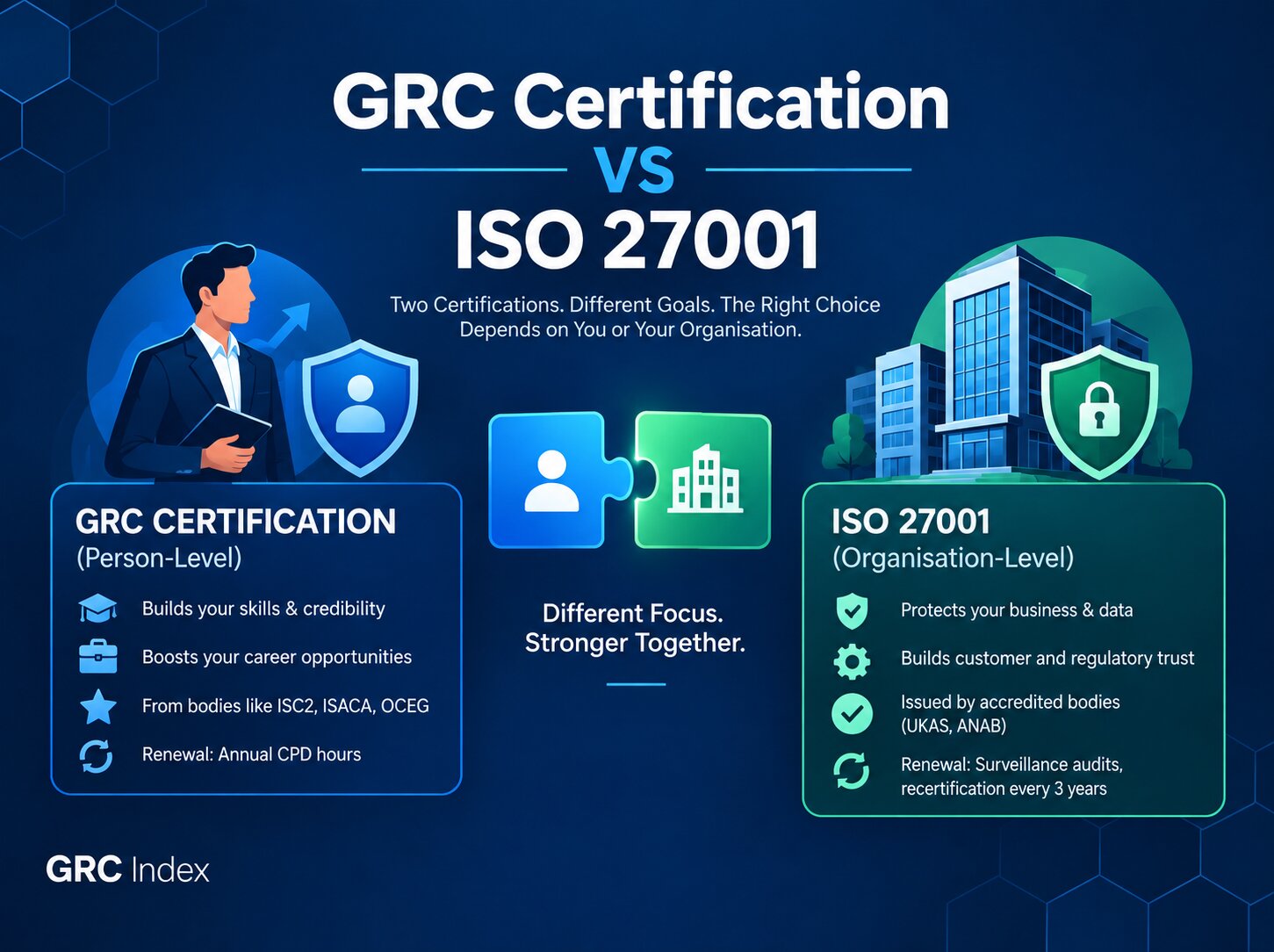
A GRC certification is a professional title that indicates someone knows how to handle the governance, risk management, and compliance of a company. You can learn & earn it through study, an exam, and often a set number of professional hours. The most popular study options include ISC2's CGRC, ISACA's CRISC, and OCEG's GRCP. Employers use these credentials to check a candidate's knowledge before hiring them into a risk or compliance role. Nobody audits your company because you hold one. Your employer gains a skilled analyst. After all this, your organisation still needs its own separate route to prove its security posture, and that is ISO 27001.
What Is ISO 27001? (Organisation-Level Standard Explained)
It's a framework that help businesses can follow to keep their private information safe. Businesses can use the standard to learn how to set up an Information Security Management System (ISMS). One way to keep business data safe is with an ISMS, which is a set of rules, policies, and technology tools. According to the ISO Survey 2024, over 96,000 organisations worldwide hold a valid ISO 27001 certificate.
GRC Certification vs ISO 27001: What's the Core Difference?
The difference between GRC Certification and ISO 27001 comes down to who gets assessed. GRC certification tests a person's knowledge. ISO 27001 tests an organisation's controls like operational control testing, technical assessments and audits. One expires when you stop renewing your CPD credits. The other expires when your certification body withdraws it after a failed audit. You can hold a GRC certification and work at a company with zero formal security certification. Equally, a fully ISO 27001-certified company might not employ a single GRC-certified staff member. Neither replaces the other.
Who Gets Certified: You or Your Company?
It totally depends on the certification you want. Ask yourself a simple question first. Are you building your own career, or are you protecting your business? A GRC certification sits on your CV and follows you between jobs. ISO 27001 sits with your employer and stays behind if you leave. Increase your salary and job prospects, and a personal credential is the right move. Run a business chasing enterprise contracts, and you need the organisational standard instead.
Side-by-Side Comparison Table
How Do GRC Certifications and ISO 27001 Work Together?
Governance, Risk, and Compliance (GRC) ISO 27001 work together to make a business safe by giving you the people skills (GRC) and the practical standard (ISO 27001). Big companies use both, not one or the other. Staff holding GRC certifications design and run the risk processes an ISO 27001 audit later examines.
A CRISC-certified risk manager builds the risk register. A CGRC-certified analyst writes the policies. The audit then confirms those policies hold up in practice. Certified people build stronger management systems, and stronger management systems pass audits faster. Skip the people side, and your ISMS documentation often looks tidy on paper but fails under real scrutiny.
Which One Does Your Career or Business Actually Need?
Individuals chasing a compliance, audit, or risk career benefit most from a personal GRC certification first. Recruiters filter CVs by these credentials constantly. Businesses selling to business owner clients, government bodies, or regulated sectors need ISO 27001 far more urgently. Contracts increasingly demand it as a condition of doing business, not a nice extra. There are many startups that hire a GRC-certified person first, then build toward full ISO 27001 certification once revenue justifies the audit cost.
Common Mistakes People Make When Comparing the Two
People often confuse ISO 27001 (a specific, auditable standard for an Information Security Management System) with GRC (Governance, Risk, and Compliance, a broad organizational discipline and software category).
Common Mistakes
- Starting with audit requirements: Picking a GRC tool based on how cool its dashboards look instead of how well it helps connect risks to Annex A controls, keep records, and back up internal audits.
- Seeing GRC as a direct replacement for ISO 27001 certification: Considering that buying a GRC Platform immediately means you are compliant with ISO 27001. GRC is a management framework and set of tools: ISO 27001 is a separate, certifiable standard that needs clear scope definitions, risk assessments, and a Statement of Applicability.
- Managing ISO 27001 like a one-time IT job instead of an ongoing process: Thinking that passing the first audit was the end goal, but real ISO 27001 and GRC need a regular schedule of reviews, tracking, and improvement.
- Trusting automatic GRC templates without templates: Assuming that compliance automation platforms' pre-built policies or risk scenarios are "audit-safe by default," which results in general paperwork that doesn't stand up to close examination by real auditors.
What Should You Choose?
If you want to grow your personal expertise and career options then you should choose GRC certification. On the other hand, if you run a business that needs to prove its security posture to the outside world, then choose ISO 27001. Most mature organisations end up needing both, running side by side. Start wherever matches your current goal, then build toward the other over time.
If you are not sure where your organisation currently stands? GRCI.net's free GRC assessment benchmarks your governance, risk, and compliance maturity against ISO 27001, SOC 2, and COSO in just 10 minutes, and gives you a GRC Score plus a prioritised list of gaps to close. Prefer to build your personal credentials first?
GRCI's training and certification courses cover GRC Essentials, ISO 27001, and SOC 2. You can also check the GRC Index to see where organisations like yours already stand.
What Mistakes Do Companies Make During GRC Certification?
Companies treat certification as a paperwork exercise rather than a living system, and auditors spot the difference fast. Companies pick a framework that matches their ambition rather than their real regulatory exposure, and lose months on the wrong standard. Companies skip the internal audit step, then fail the real one on issues a proper internal check would have caught for free.
Poor evidence trips up nearly every company at least once. Screenshots go missing. Sign-off logs run months out of date. Version control on policies breaks down the moment two departments edit the same document apart.
Your company can avoid most of these mistakes with the right guidance from the start. The GRC Index lists 1,100+ organisations already benchmarked against COSO, ISO 27001, and SOC 2, so you can your team also sees exactly where the bar sits before your own audit begins.
.jpg)