

Why European Organisations Need a GRC Score in 2026
Imagine you win a tender shortlist. Your product is strong, your team is capable, and the pricing is fair. Then the buyer sends a security questionnaire. Fifty-four questions, a request for your ICT third-party inventory, evidence of continuous control testing, and a signed attestation from your board. You have none of it in one place. You lose the contract.
That situation is not hypothetical. It is the daily reality for European organisations in 2026 that do not have a verifiable GRC Score. Four EU regulations are now in active enforcement simultaneously. Buyers, insurers, investors, and regulators all read the same signal: do you have documented, scored governance, or do you have a folder of expired certificates?
You do not need more certificates. You need a score.
Why Does a Folder Full of Certificates No Longer Close a European Deal?
Three years ago, (2023) an ISO 27001 certificate was enough on your website to pass most supplier vetting processes. You sent it over, the procurement team filed it, and the deal moved forward. That era is over.
But now in 2026, enterprise buyers across Europe run structured questionnaire processes before any contract is signed. These are not quick tick-box forms. They ask for evidence of continuous monitoring, ICT third-party inventory, board-level accountability statements, incident response procedures, and recovery testing results. A certificate tells a buyer you passed an audit on a specific day. It tells them nothing about what your controls look like today.
The questionnaire fatigue problem is real and it runs in both directions. Buyers are exhausted by collecting self-certified answers that cannot be verified. Suppliers are exhausted by filling in the same questions forty different ways for forty different customers. According to EIOPA's 2024 review of DORA readiness, 34% of European financial entities could not produce a complete ICT third-party inventory when asked. That is not a documentation problem. It is a governance problem, and it shows up immediately in any serious supplier vetting process.
A GRC Score changes the total dynamic. It replaces eighty pages of questionnaire responses with a single, independently verified number benchmarked against recognised international standards. The buyer sees it. The insurer sees it. The regulator sees it. And you only have to earn it once, then maintain it.
You can start your free GRC assessment at GRCI and see where your organisation stands today. The first score takes around nine minutes to produce.
Which 2026 Rules Turned Governance into a Scoreboard?
European organisations did not choose to operate under four overlapping regulatory frameworks at the same time. That choice was made for them between 2022 and 2024, and the full weight of it landed in 2025 and 2026. You need to understand what each framework demands, because every one points toward the same destination: a documented, evidence-backed, continuously monitored governance posture. In other words, a score.
What Changed When NIS2 Reached the Court of Justice?
NIS2 came into force across the EU in October 2024, extending its reach far beyond the original NIS Directive's scope. The new directive covers essential entities and important entities across 18 sectors, including energy, transport, banking, health, digital infrastructure & managed service providers. If your organisation fit any of those sectors, as a direct operator or as a supplier, you are in scope.
The most significant change NIS2 introduced is not the scope. It is the liability. Under Article 20 of NIS2, senior management is personally accountable for cybersecurity risk management. Board members and directors can face personal fines if their organisation fails to implement adequate measures. This is not a corporate penalty that disappears into the accounts. It follows individuals.
NIS2 also requires organisations to assess the security practices of their direct suppliers and service providers. Your GRC Score is, in part, your suppliers' problem too, and theirs is yours.
What Does DORA Demand from Your Customers, and Then from You?
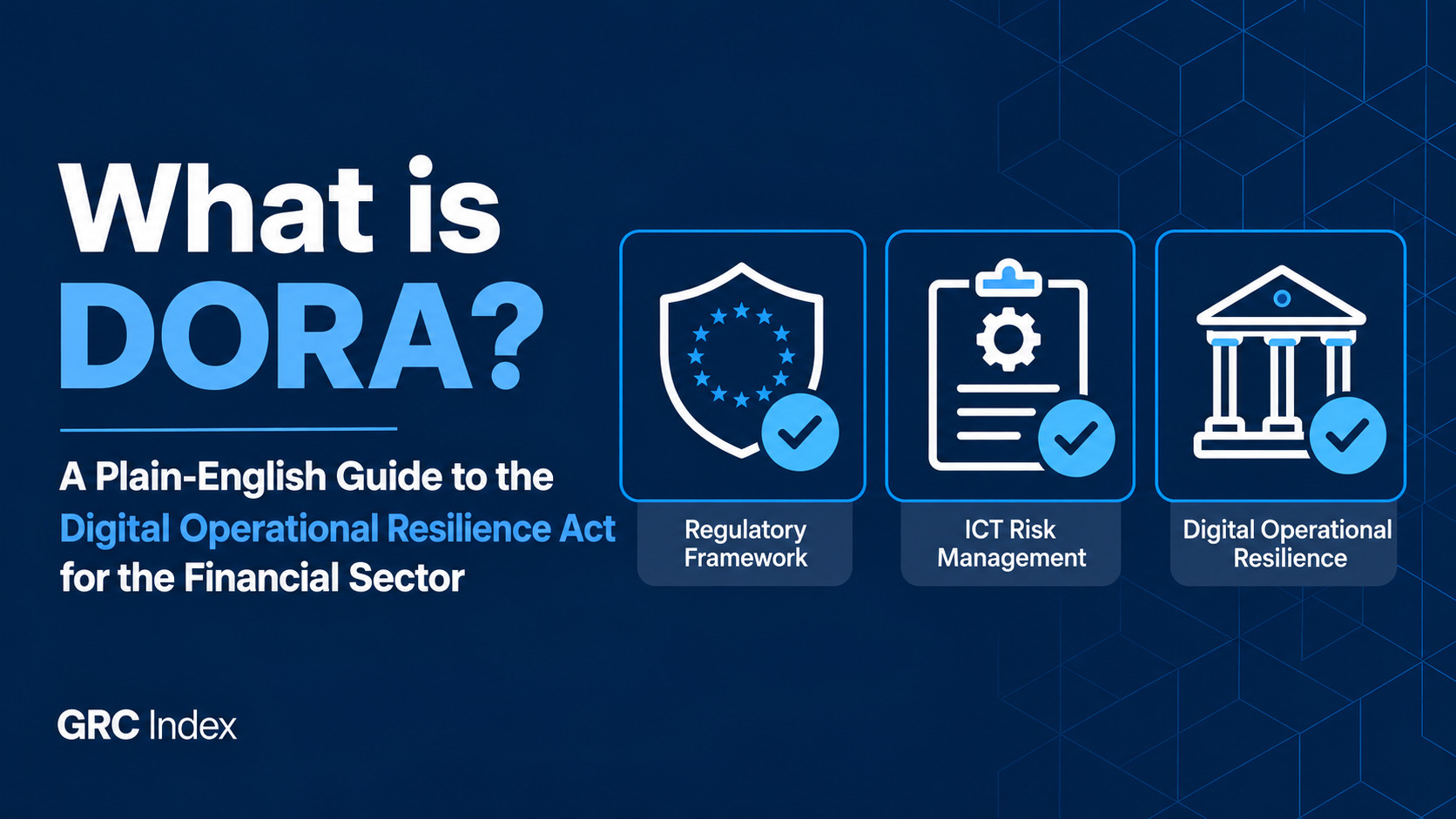
The Digital Operational Resilience Act (DORA) became fully applicable to EU financial entities in January 2025. It covers banks, insurance firms, investment firms, payment institutions, crypto-asset service providers, and critically, their ICT third-party service providers. If you sell software, hosting, data analytics, or any technology service to a regulated financial entity in the EU, DORA applies to the relationship, even if it does not apply directly to you.
What DORA demands is not a one-time audit. It demands continuous ICT risk management, documented incident classification and reporting, regular resilience testing, and a complete register of all ICT third-party dependencies. The European Supervisory Authorities can examine these registers at any time.
Which AI Act Duties Survived the Digital Omnibus?
The EU AI Act entered its first enforcement phase in February 2025, banning prohibited AI practices and introducing obligations for providers and deployers of general-purpose AI models. The broader risk-classification obligations for high-risk AI systems apply from August 2026. The European Commission's Digital Omnibus proposal, published in early 2026, proposed some procedural adjustments, but the core duties on transparency, conformity assessment, and human oversight remained unchanged.
If your organisation uses AI tools like (Vanta, Sprinto and more) that interact with customers, make decisions about individuals, or operate within critical sectors, you may already have AI Act obligations. The governance requirement is clear: you must document what AI systems you use, classify them by risk level, maintain technical documentation, and assign human oversight responsibility.
TIMELINE DIAGRAM: EU Regulatory Enforcement Milestones
What Happens When Your Evidence Lives in Twelve Spreadsheets?
There are many European organisations do not have a governance problem. They have a fragmentation problem. The evidence is there policies written, controls tested, audits completed, but it lives in twelve different spreadsheets, three shared drives, two email threads, & one consultant's report from eighteen months ago.
When a regulator, a buyer, or an insurer asks for your audit trail, you cannot point to a spreadsheet and call it governance. You need a single, traceable record of what your controls are, who owns them, when they were last tested, and what the evidence shows. Without that structure, evidence assembly before an audit takes weeks. Control gaps go undetected between review cycles. And when something goes wrong, you cannot demonstrate that you did everything a reasonable organisation would have done.
The fragmentation cost is not just regulatory. A 2024 Ponemon Institute study on the cost of compliance found that organisations with mature, integrated compliance processes spend 31% less on compliance activities than those running fragmented programmes. That is time and money returned to the business, not absorbed by a pre-audit scramble.
How Much Does a Weak Score Cost You in 2026?
Compliance is often framed as a cost. It is worth reframing it as an insurance question: what does non-compliance cost, and is that number bigger?
Under NIS2, essential entities face fines of up to €10 million or 2% of global annual turnover, whichever is higher. Important entities face fines of up to €7 million or 1.4% of global turnover. These are maximum figures, but enforcement in 2026 is not theoretical.
Belgium's Centre for Cybersecurity issued its first NIS2 enforcement notices in late 2025, targeting healthcare and energy operators with documented control failures. Italy's ACN issued corrective orders to digital infrastructure providers following incident reporting failures. Hungary's SZTFH opened formal investigations into several important entities that missed the ICT risk management implementation deadline. These are not warnings. They are the leading edge of an enforcement wave.
DORA fines for ICT-related violations follow a similar ceiling structure, with the ESAs empowered to name non-compliant entities publicly. For financial service providers, a public naming under DORA is not a compliance problem. It is a commercial one. Counterparties, investors, and customers all read supervisory authority publications.
Then there are the indirect costs. A weak GRC posture adds a loading to cyber insurance premiums, which have risen an average of 18% year-on-year across Europe since 2023, according to the European Insurance and Occupational Pensions Authority. Organisations without documented controls, resilience testing records, and third-party inventories are placed in higher-risk categories at renewal. Some are declined outright.
Lost tenders represent the quietest but most consistent commercial cost. Public sector procurement in the EU increasingly requires suppliers to demonstrate security and governance standards as a pass/fail condition, not a scoring criterion. If you do not meet the minimum, you do not get evaluated. A verifiable GRC Score clears that gate.
Who Reads Your Score Before They Sign?
A GRC Score is not a credential once you file and forget. It is a signal read by multiple audiences, each one looking for something different. You need to understand what each audience wants, because the same score answers different questions for every of them.
The buyers question: why does a folder of certificates no longer close a deal, has a simple answer when you look at this table. Each audience needs something different from your governance posture. There is only one question that a certificate can answer at a time. A GRC Score answers all five questions continuously, from a single source of truth.
You can see how scored organisations present themselves to these audiences by reviewing the GRC Index public listings at GRCI. Each listed organisation shows its score, the domains it has been assessed across, and the standards its assessment is aligned to. That is the level of transparency buyers, insurers, and investors now expect.
Where Does a GRC Score Sit Next to ISO 27001 and SOC 2?
This is the most important question that causes the most confusion, and it is worth clearing it up directly. A GRC Score does not replace ISO 27001 or SOC 2. It does not compete with them. It sits above them, using them as evidence inputs.
What Separates a Scored Organisation from a Certified One?
Certification tells the market and the users like you met a standard. A score tells the market where you stand on a continuous spectrum, and where you are headed.
The commercial difference is real. A buyer evaluating two suppliers, one with an ISO 27001 certificate dated fourteen months ago, and one with a current GRC Score of 78 out of 100, benchmarked against 1,100 other organisations in their sector, has far more usable information from the second supplier. The certificate is a pass/fail answer to a single question. The score is an answer to the full due diligence conversation.
The relationship dimension matters too. A public GRC profile changes how prospects approach you. Instead of opening with a questionnaire, they open with a reference. Your score is already there. Your domains are already visible. Your standards alignment is already documented. The conversation starts two stages further along.
For regulated buyers running DORA supply chain assessments, this matters enormously. Their obligation under Article 28 is to assess and document the ICT risk their suppliers carry. A verified GRC Score, independently reviewed, evidence-backed, and publicly listed, satisfies a significant portion of that assessment obligation. You reduce their compliance burden. That is a commercial advantage, not just a governance one.
How Do You Move from a Gap List to a Defensible Score?
Many organisations that look honestly at their governance position find the same thing: they know roughly where the gaps are, but they have no structured way to measure them, close them in the right order, or demonstrate improvement to an outside audience. Here is how you move from awareness to a score that holds up under scrutiny.
Step 1: Complete the structured assessment.
The GRCI assessment is aligned to COSO, ISO 27001, SOC 2, ISAE 3402, and ISAE 3000. You answer a structured questionnaire covering all five governance domains and submit documentary evidence, existing policies, control records, audit outputs, and board minutes to validate your answers. It takes around nine minutes to produce your first indicative score.
Step 2: Undergo expert review.
Both algorithmic grading and independent GRC expert reviewers look over your application. They evaluate your evidence across all five domains: Governance, Risk Management, Compliance, Resilience, & Data Security.
Step 3: Receive your scored report.
Approved organisations receive a GRC Score, a public profile in the GRC Index, and a prioritised set of improvement recommendations. Your score reflects your current posture, not an aspiration. Your public profile reflects it to every buyer, insurer, and investor who checks.
Step 4: Address your priority gaps.
Your scored report identifies which domains are dragging your overall score down and what specific controls or evidence gaps are responsible. You close the highest-impact gaps first. For structured training support across ISO 27001, SOC 2, ISAE 3402, & ISAE 3000, GRCI's training and certification programmes cover all the frameworks your score is assessed against.
Step 5: Re-score and demonstrate progress.
As your governance matures, your score rises. That trajectory a rising score over successive assessment periods is itself a governance signal. It tells buyers you are not just compliant today but improving continuously. It tells regulators you have a functioning governance programme, not a point-in-time exercise.
Step 6: Maintain your public profile.
Your GRC Index listing is a live reference for everyone who needs to assess your governance posture. It removes the questionnaire burden, it satisfies supply chain due diligence requirements, and it signals to the market that your governance is transparent and independently verified.
European regulatory enforcement data referenced from EIOPA, the Belgian Centre for Cybersecurity, Italy's ACN, and Hungary's SZTFH. Compliance cost data from IBM Security and Ponemon Institute. All GRCI assessment and scoring information from grci.net.

.jpg)