
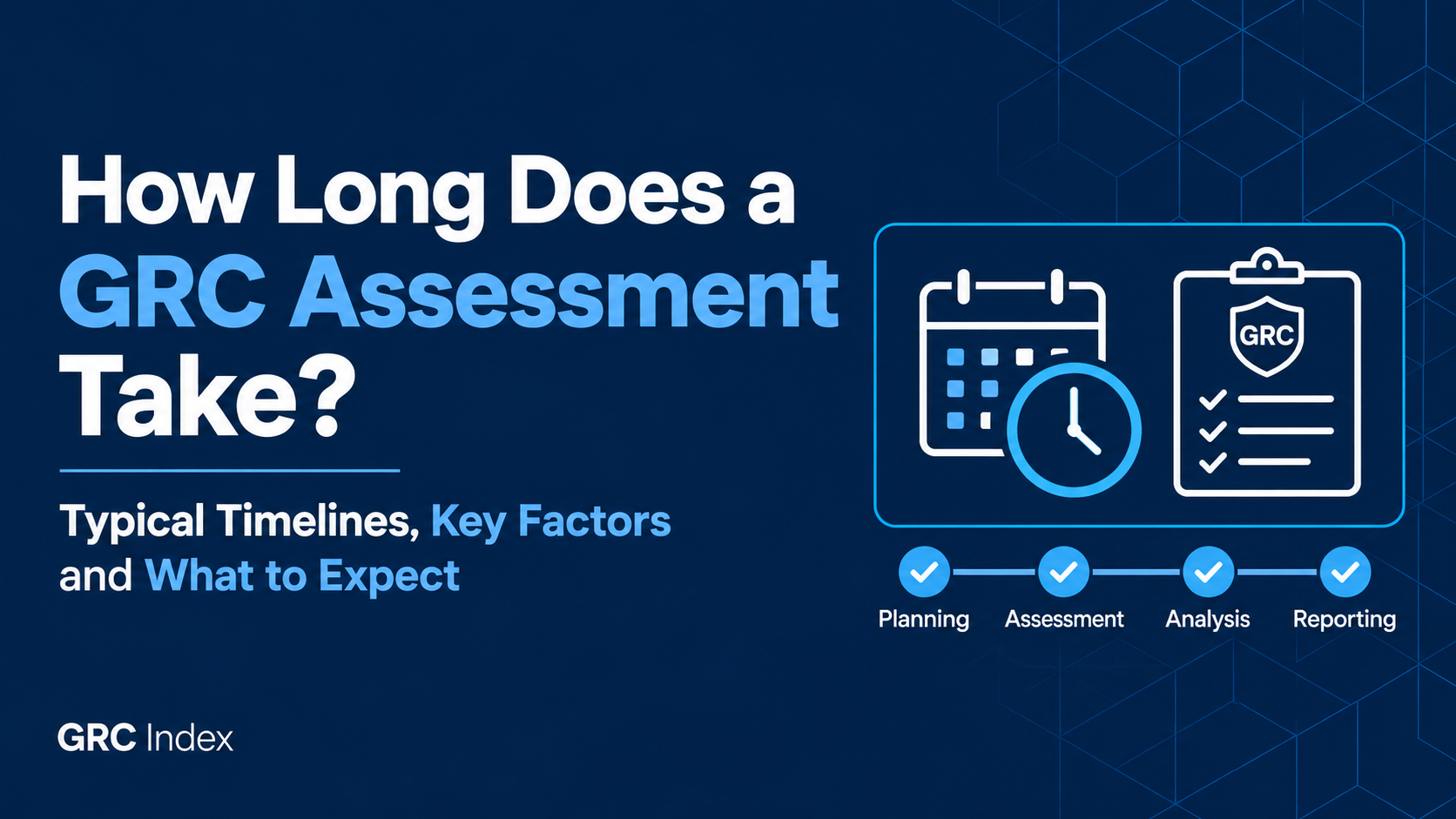
How Long Does a GRC Assessment Take?
A GRC assessment can take twenty minutes or three days. An online GRC index tool can give you a score in less than half an hour. A full review across some frameworks needs 1 to 3 days of direct work with your team. The final written report follows 5 to 10 business days later.
A consultant-led review of one framework often runs four to eight weeks from the first call to the final report, a range that holds across most organisations once you account for size and paperwork. Formal assessments of this kind average four to eight weeks, and most organisations complete an initial GRC review within that same window, depending on complexity and how ready the evidence already is. So what explains the gap between twenty minutes and eight weeks? The format you pick sets the floor and the ceiling, not the framework itself. In Short: GRC assessment can take 20 Minutes to Three Days.
What Decides Your GRC Assessment Timeline
Three things fix your timeline. The format you choose sets the floor. The number of frameworks in scope adds days on top of that floor. The state of your current paperwork decides whether you land near the floor or near the ceiling.
You should treat these three points as a short checklist before you book any assessment. A clear answer on each point gives you a real date, not a maybe or guess. Vague answers push your project toward the slow end of the range every time.
Three Assessment Formats and Their Real Timeframes
Not every GRC assessment looks the same, and the format you pick changes the clock more than anything else. Three formats cover almost every case a UK organisation runs into. Each one suits a different stage of your compliance path.
Self-Assessment Questionnaires
A self-assessment tool gives you a score in fifteen to thirty minutes. You answer a set of structured questions online, and the tool scores your answers against a chosen framework straight away. The result works well as a first look at your position. A board update or a client request, however, usually needs more depth than a quick score can give.
Consultant-Led Assessments
A consultant-led review of one framework needs that same four to eight week window, most of it spent on document review and follow-up calls rather than site visits. Your consultant works through your policies first, then schedules interviews with the people who own each control.
Multi-Framework Assessments
A multi-framework review covers different standards in one pass and needs one to three days of direct work with your team. GRC Index runs this format across five frameworks: COSO, ISO 31000, ISO 27001, NIST CSF and SOC 2. Your written report follows five to ten business days after the engagement ends.
A Day-by-Day Breakdown of a Full Assessment
Day one covers stakeholder interviews and a first pass through your policy set. Day two maps your current controls against each target framework and flags every gap. Day three closes with a wrap-up call and a draft summary for your leadership team.
Your full written report lands five to ten business days after day three ends. The report gives you a maturity score, a list of gaps and a plan you can hand straight to your board. A three-day engagement, in short, buys you months of clarity before a formal audit even starts.
Five Factors That Stretch or Shrink Your Timeline
Framework count. One framework moves faster than five. Each extra standard adds its own set of controls to check.
Organisation size. A small team in one office finishes faster than a group with several sites. More departments mean more people to interview.
Document readiness. Current policies and an active risk register cut real days off the review. Gaps in your paperwork add those days straight back.
Stakeholder availability. Interviews only happen once your senior team confirms a slot. A packed diary pushes the whole timeline back by weeks.
Automation. Automated evidence tools cut real time off the readiness stage, often two to four months on a typical project. A compliance automation platform saves an average of two to four months off a readiness timeline.
Assessment Time vs Audit Time
An assessment and a formal audit run on two separate clocks. Your assessment wraps up in minutes to days. A SOC 2 audit alone often takes three to twelve months.SOC 2 compliance usually takes between three and twelve months, based on the report type and how ready your controls already are. ISO 27001 certification for a UK organisation with a broad scope commonly runs nine to eighteen months from the first workshop to the final certificate.
Typical implementation timelines for organisations of this kind range from nine to eighteen months, based on scope size, existing control maturity and resource availability. That gap in scale explains why so many boards run an assessment before they commit to a full audit cycle. You can read in a detailed guide on GRC assessment vs GRC audit sets out that full relationship in detail. Our piece on SOC 2 Trust Services Criteria covers what a SOC 2 audit actually checks once your organisation reaches that stage.
How to Shorten Your Assessment Timeline
You should gather your current policies and risk register before day one starts. It is important to confirm every stakeholder's diary slot a week ahead of the engagement. You should pick one framework first if your team is new to GRC, then add others once that first review clears. A same-day score becomes possible the moment you switch to an automated self-assessment tool.
Your Timeline at a Glance
In this table, you can set out each option side by side. Use it as a quick reference the next time your board wants a straight answer on how long an assessment takes.
Start Your GRC Assessment
GRC Index runs a twenty minute self-assessment that covers COSO, ISO 31000, ISO 27001, NIST CSF and SOC 2 in one pass. You get an instant score first, then a full written report from our team within ten business days. You can start your assessment today and get a clear read on where your organisation stands.