
Over the past few weeks, Recent incidents involving supplier platforms, stolen credentials and connected equipment show how cyber exposure can extend beyond an organisation’s main IT environment. The trouble began at a technology supplier, on a third-party platform, or in equipment bought from a vendor.
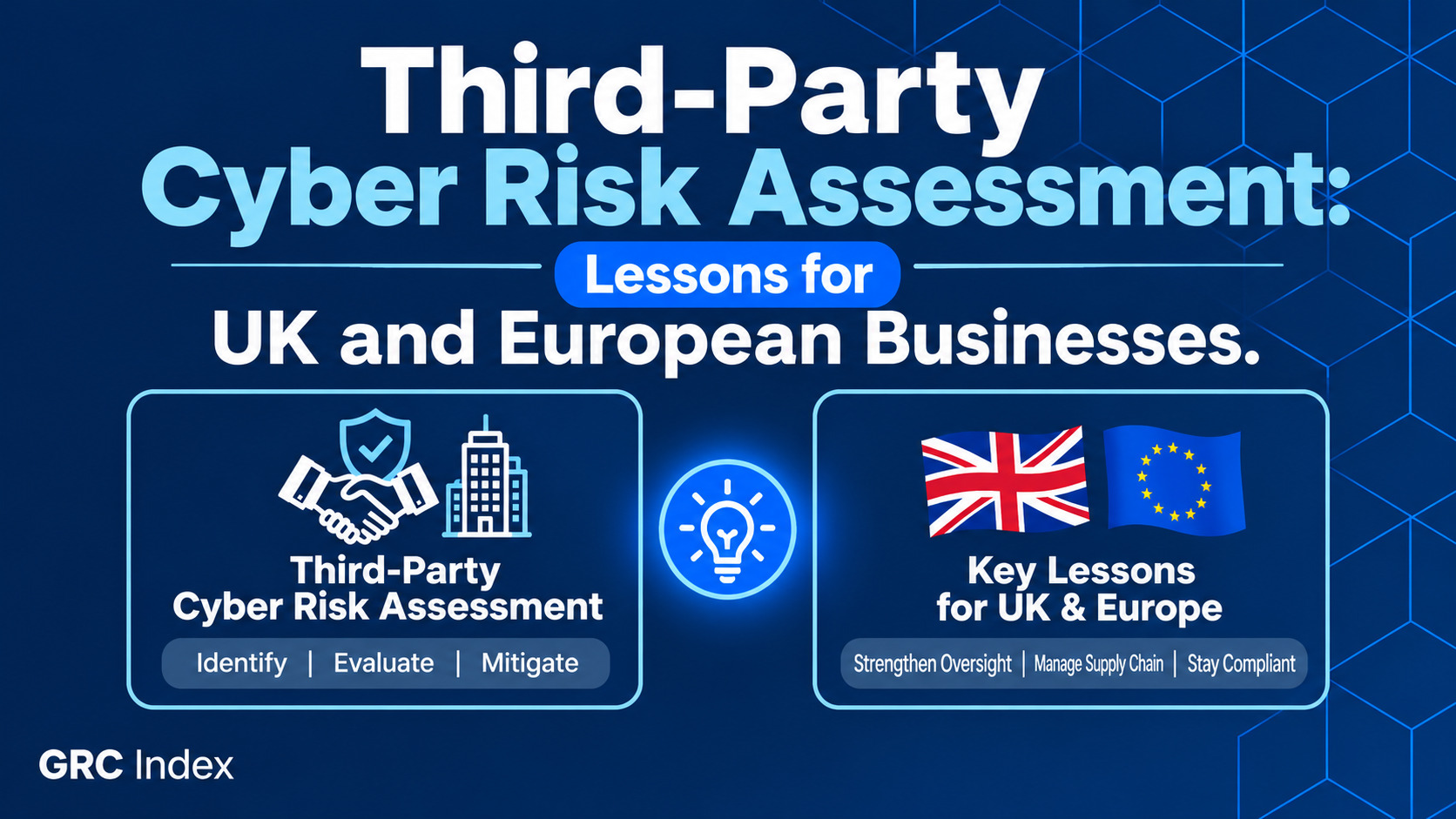
A third-party cyber risk assessment asks three plain questions: which suppliers hold your data, which can reach your systems, and which could you not run without? This article uses recent incidents to show what to check, what evidence to ask for, and where GRCI fits. It is written for risk, compliance, security and procurement leaders. This article is written by the GRC Index team. Nothing here predicts that your organisation will be hit. The aim is a clearer view of your own position.
What Recent Cyber Incidents Reveal About Third-Party Risk?
What Has Been Confirmed and What Remains Uncertain?
Three recent cases show different ways a third party can matter. The details below are as reported on 24 November 2026 and may change.
What Should Your Organisation Learn From These Incidents?
None of these reports links the three incidents, so they should not be read as one campaign. They differ in type, but they share a lesson. An organisation can be affected, or be asked hard questions, even when its own network is untouched. An incident anywhere else is a reason to check your own arrangements. It is not proof that you have been compromised.
Could a Supplier Expose Your Data or Disrupt Your Operations?
Which Suppliers Hold Sensitive Information?
Start with a list. Payroll providers, CRM platforms, cloud storage, and outsourced professional services often hold personal or commercial data. For each one, record what information it holds, why, who in your organisation owns the relationship, and who at the supplier can see the data.
Which Suppliers Can Access Your Systems?
Holding data is not the same as having access. Keep four groups apart: suppliers that process or store your information, those that can log in to your systems, those with privileged permissions such as administrator rights, and those that use subcontractors. According to the ICO guidance, a processor stays liable to the controller for the compliance of any sub-processors it uses, so you need to know they exist.
Which Services Could You Not Operate Without?
For example, a regional distributor might take every order through one cloud ordering system. If it is down for three days, orders stop even though no data is stolen. That is an operational dependency.
A short self-check:
- Which five suppliers would hurt most if they were offline for a week?
- Which suppliers hold personal data about customers or staff?
- Who outside your organisation can log in to your systems?
- Which suppliers rely on subcontractors, and do you know who they are?
- How would you learn of a supplier incident, and how quickly?
These questions touch supplier oversight, risk ownership and operational resilience, which GRC Index’s About GRC page lists among the areas its assessment covers.
What Evidence Should You Review Before Assuming Your Organisation Is Secure?
Feeling covered is not the same as being able to show it.
Policies and controls that reflect current operations
Useful evidence has four traits: a named owner, a recent review date, a clear scope, and proof that the control is used. An access policy is a start. A record of the last access review, with names and dates, is stronger.
Supplier assurance and contractual responsibilities
Ask for relevant assurance reports or security certifications, then check their scope, date, exclusions, and applicability to the service you use. A certificate for one product may say nothing about the service you buy. Read the contract for security duties, incident notification times and subcontractor rules, and list any open exceptions. Under UK GDPR, controllers should only use processors that can give sufficient guarantees on security, and processors must tell the controller about a breach without undue delay.
Incident response and recovery arrangements
Know who decides, who calls whom, and how you recover. Then check whether the plan has been tested, and when.
This is why GRC Index separates two stages. The homepage says a verified result follows evidence review, and that an initial self-assessment is not independent verification. If collecting the evidence above exposes gaps, you could start your self-assessment as a baseline.
Why Cybersecurity Is Also a Governance, Risk and Compliance Issue
Governance determines ownership and accountability
Someone has to own the supplier list, approve the risks you accept and make sure actions happen. If the board only hears about suppliers after an incident, governance has a gap.
Risk management determines priorities
It is not possible to fix everything at once. Risk management ranks which dependencies matter most, so effort goes where a failure would hurt most.
Compliance connects obligations to evidence
Law and contracts set duties on personal data, security, and reporting. Compliance links each duty to evidence you can show.
GRC Index describes these three as one connected view, where leadership, risk decisions and compliance evidence inform each other instead of sitting in separate reports. You can check our About GRC page, which explains the idea in more detail.
How GRCI Helps You Understand Your Position and Prioritise Improvements
GRC Index assesses governance, risk and compliance maturity. The assessment described here evaluates GRC maturity; it should not be treated as technical monitoring, penetration testing or incident response. What we offer is a structured way to see where you stand. The steps below follow GRCI's own descriptions of its process.
Establish a starting point through self-assessment
The self-assessment questionnaire asks, for instance, how often your board reviews risk, which certifications and audit reports you hold, whether you have an approved data security policy, and what your priorities are, including third-party and supply chain risk. GRC Index emails your initial score. Only retain this if the current journey confirms it. Ask people from risk, security, compliance and procurement to answer together, so the result is not one person's view. It is a starting point, not independent verification.
Support the assessment with organisational evidence
Organisations can submit supporting material for evidence review, such as policies, procedures, audit outputs and controls documentation, for review by independent expert reviewers (About Us). The benefit is a clearer line between what you say you do and what your documents support.
Understand strengths and gaps behind the score
The report shows domain-level results with red, amber and green ratings and a summary of the main gaps. That lets management see where attention is needed instead of relying on one headline number.
Turn findings into improvement priorities
The output includes a prioritised action plan with impact and effort ratings. Your team can use the findings to assign owners, estimate resources and agree target dates. Acting on the plan stays with your teams. GRC Index site describes assessment and reporting, not delivery of the fixes.
Communicate the assessed position more clearly
A documented result can help when you talk to your board, audit committee, clients or auditors. GRCI describes the report as board-ready. It reflects your position within the assessment's scope and date, and it does not mean a regulator or customer will accept it.
Develop capability and review progress
GRC Index also runs online training, including GRC Essentials and courses on DORA and NIS2, and says organisations that assess each year can track results year on year. Attending a course does not prove controls work, but reassessment can show whether your changes made a difference. If you want to see the process before you begin, understand how GRCI assessment works.
What a GRC Score Can and Cannot Tell You About Data Security
What the assessment can help you understand
It can show how mature your assessed arrangements are, what evidence supports them, where the gaps sit and what management should deal with first. If you assess again later on a comparable basis, it can show progress.
Why a score is not a security guarantee
A score does not predict whether you will be breached, and it does not replace running and maintaining controls. Read any result alongside its scope, its evidence and its date. A self-assessed result and an evidence-reviewed result are different things.
It also helps to know what an assessment is not. Supplier due diligence looks hard at one supplier's controls, contracts and reports. Technical testing, such as vulnerability scanning or penetration testing, looks for weaknesses in systems. In the refrigeration attacks, affected firms were reportedly running firmware that had a fix available since August. Finding that kind of gap takes technical checks. A GRC assessment can ask who owns patching and how that is evidenced, but it does not scan your equipment.
Which UK and European Requirements Should Shape Your Review?
Europe and the European Union are not interchangeable. The UK is geographically part of Europe but is not an EU member. The rules are different by country, sector and organisation, so treat this as a set of prompts and take legal advice on your own position.
UK organisations: identify the obligations relevant to your activities
UK GDPR applies to personal data. If a breach is likely to put people at risk, you must tell the ICO as soon as possible and, where feasible, within 72 hours, which is hard if you hear about a supplier breach late. The existing NIS Regulations 2018 cover certain essential services, and the Cyber Security and Resilience Bill would reform and add to them. It finished House of Lords report stage on 26 October 2026, so check its status before relying on it.
EU organisations: consider GDPR, NIS2 and DORA where in scope
NIS2 applies to ‘essential’ and ‘important’ entities and lists supply chain security among the measures they must address. EU Member States were required to transpose NIS2 into national law by 17 October 2024, so national laws vary. DORA applies from 17 January 2025 to financial entities and includes ICT third-party risk rules. Neither applies to every organisation.
Cross-border organisations: connect overlapping requirements
If you operate in both the UK and EU, or serve customers there, more than one regime may apply. The themes overlap: ownership, supplier oversight and incident handling. Mapping your duties once and keeping one evidence set can reduce duplicated work without hiding real differences. Name GRCI explicitly and add the relevant link, rather than leaving an editorial note in the article. That supports your understanding. It is not legal advice or certification.
What Should Your Organisation Do Next?
- Identify your most important data and supplier dependencies. Output: a ranked list of suppliers, the information they hold, and the services you rely on.
- Collect evidence and record what you cannot answer. Output: an evidence register with owners and review dates.
- Assign actions and decide whether an assessment is needed. Output: an improvement list with owners and follow-up dates.
A self-assessment is one sensible next step if you want a clearer baseline. It is not the only useful one.
Start by Understanding Where Your GRC Stands
Before you tell a board or a client that your suppliers are under control, find out what your evidence supports. Self-assessment gives you a starting point. Evidence review comes afterwards.
When you start your self-assessment, you answer a short questionnaire and give your name, company and work email, and GRC Index emails your score.
Frequently Asked Questions
Can a Supplier Cyberattack Affect Us Without Breaching Our Own Systems?
Yes, in three ways: your information can be exposed at the supplier, a supplier's access to your systems can be misused, or a service you depend on can stop. Next says its own systems were not compromised, yet a supplier incident exposed some data relating to it.
How Can GRCI Help Us Assess Data-Security and Supplier Risks?
Through a self-assessment, supporting evidence, domain-level findings and recommendations. GRC Index describes the assessment as covering areas such as governance, risk, compliance, information security, resilience, and third-party risk. It is a maturity assessment. It does not provide technical protection or testing.
Is the Initial Self-Assessment Independently Verified?
No. The initial self-assessment is not independently verified; verification follows evidence review.
Does a High GRC Score Mean Our Organisation Cannot Be Hacked?
No. A score reflects the maturity of the arrangements assessed, within a scope and at a date. It does not predict or prevent an attack, and it does not replace maintaining controls.
What Information Should We Prepare for a GRCI Assessment?
For a Governance, Risk, and Compliance (GRC) review or assessment, you should provide written proof of governance, risk, compliance, and operational controls instead of relying on claims made over the phone or Unsupported statements or policies without evidence of implementation