

SOC focuses on looking at internal controls over financial reporting. SOC uses the Trust Services Criteria to look at data protection and cybersecurity. The service you sell decides which report is good for you. Some firms need both SOC 1 and SOC 2, like Fintech & Payment Processors, Payroll & HR Platforms, SaaS Financial Platforms, and Healthcare Tech & Billing. A client asks you for a “SOC report”. The email does not say which one. In this article, I will explain the difference between SOC 1 and SOC 2 with a comparison, issues and when you need it.
SOC 1 Guards the Ledger, SOC 2 Guards the Vault
You can imagine two locked rooms. The first room holds a ledger of your client’s money. The second room is a vault of your client’s data. In simple words, the main difference between SOC 1 and SOC 2 is the room each report guards. SOC 1 guards the ledger. It checks the controls that can change your client’s financial statements. SOC 2 guards the vault. It checks the controls that protect data from misuse and loss.
SOC 1 and SOC 2 Side by Side
This table shows the key points at a glance.
Both reports rest on controls, which are the rules and checks your team runs each day. Your auditor reads those controls and writes an opinion. Each report goes to a limited group of readers.
What Does a SOC 1 Report Prove About Your Numbers?
A SOC 1 report is not to confirm that particular financial statistics are accurate; rather, it is to demonstrate that the internal controls that regulate the processes, IT, and data that goes into those numbers are designed and operating correctly. A payroll provider is a clear example. The provider pays wages for many clients. One wrong figure changes a client’s books. The client’s auditor therefore wants proof that the provider’s controls work.
SOC 1 has no fixed checklist. You and your auditor write control objectives that match your service. Typical objectives cover correct pay runs, proper approvals and safe system changes. The auditor then checks the controls behind each objective.
A US public company may need your SOC 1 report for its own audit under the Sarbanes-Oxley Act (SOX). SOC 1 follows the AT-C 320 section of the AICPA attestation standards. Outside the US, ISAE 3402 serves the same purpose.
What Does a SOC 2 Report Prove About Your Data?
A SOC 2 report is a licensed CPA firm's independent attestation report, which is not a permanent certificate or seal. It shows the extent to which a service provider safeguards user data in accordance with the AICPA Trust Services Criteria (TSC). The validity of a SOC 2 report is dependent upon the fundamental categories that are included in the audit scope and whether it is a Type I or Type II report.
Five criteria exist. Security is the only required one. You pick the optional ones that match your service and data. The optional four are Availability, Confidentiality, Privacy and Processing Integrity. A SaaS vendor is a clear example. The vendor stores client files in the cloud. The client’s security team asks for a SOC 2 report as proof. You can compare SOC 2 with ISO 27001 in the GRCI guide to SOC 2 vs ISO 27001.
SOC 1 Is a Tailored Suit, SOC 2 Is Off the Rack
The biggest practical difference sits in the criteria. SOC 2 comes off the rack because the AICPA fixes the criteria. SOC 1 is a tailored suit. Management defines the control objectives to fit the service.
The same control can serve both reports. Door access to a server room is a good case. A card key, a fingerprint scan or a guard can all meet the need. The auditor checks that your chosen method works.
Evidence differs as well. SOC 1 evidence leans on transaction accuracy, such as approved invoices and correct totals. SOC 2 evidence leans on security, such as access logs and change records. As a result, SOC 1 preparation needs more custom work.
SOC Type 1 Is a Photo, SOC Type 2 Is a Film
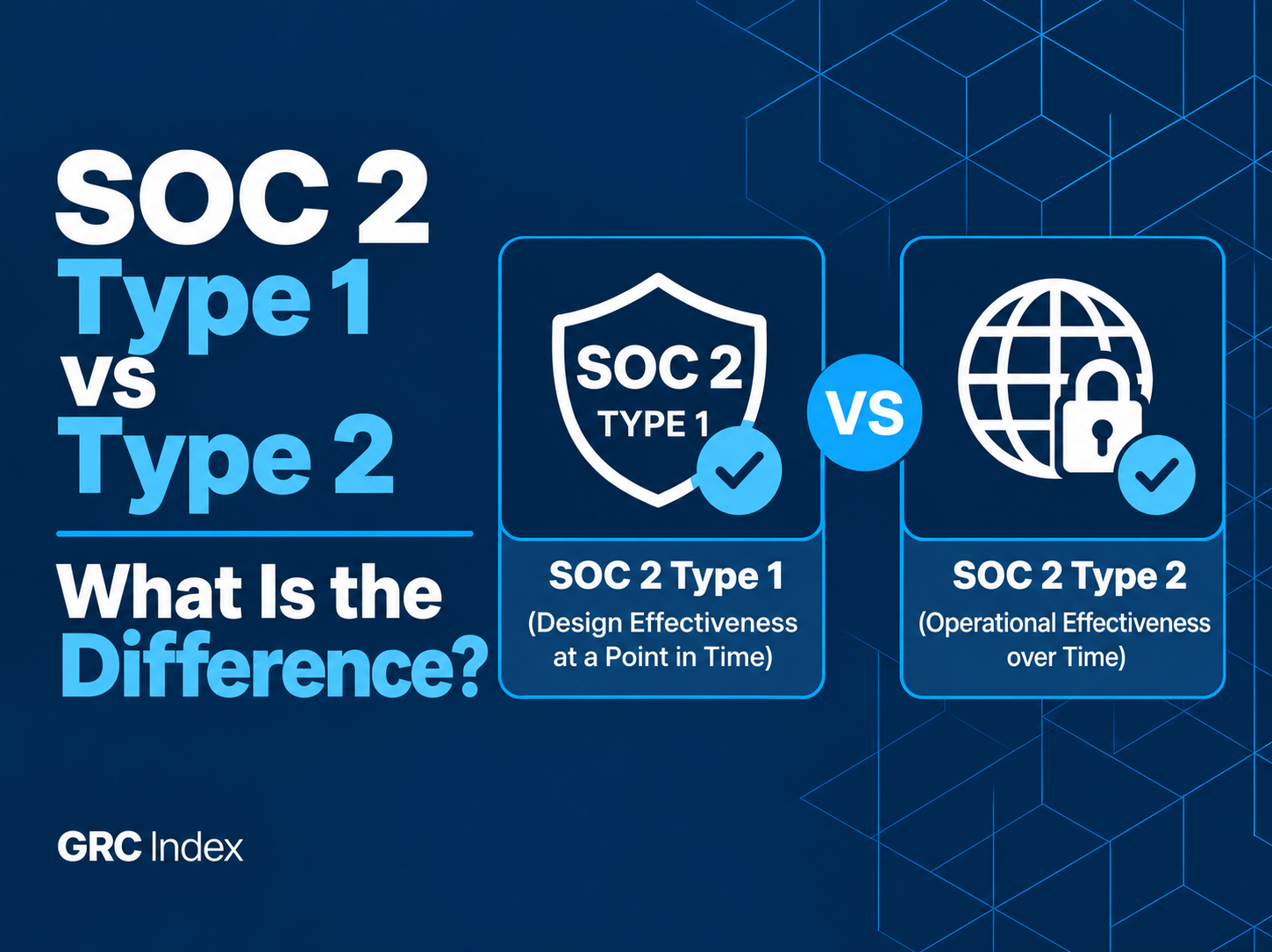
Both SOC 1 and SOC 2 come in two types. A Type 1 report is a photo. It checks if your controls are well designed on one date. It does not test how the controls perform over time. A Type 2 report is a film. It checks the design and also how the controls perform across a set period. The period is usually three to twelve months. You and the auditor agree on it. Type 1 suits a new firm that needs fast proof. Type 2 earns more trust from buyers. Large clients often prefer Type 2. You can read the GRCI guide in detail on SOC 2 Type 1 vs Type 2.
Which Door Should You Open First, SOC 1 or SOC 2?
Three questions point you to the right report. First, what service do you sell? Second, what data do you hold? Third, who asks for proof?
- SOC 1 fits a service that touches a client’s financial statements
- SOC 2 fits a service that stores or moves client data
- Both fit a service that does both
You can also ask the client one direct question. Who will read the report? A finance auditor points to SOC 1. A security team points to SOC 2. A service organisation is any firm that runs a process or system for clients. Payroll firms, SaaS vendors and data centres all count. Your clients’ risk decides your report.
Do You Need Both SOC 1 and SOC 2?
It depends on what your business does and how your services work with your clients' operations to see if you need both SOC 1 and SOC 2. Who needs both? Businesses whose services have a direct effect on the financial statements of their clients. Processing paychecks, billing, managing funds, handling claims, and servicing loans are all examples of this.
The two audits overlap. Controls such as user access and change approval appear in both. A single CPA firm can often run both audits together. Each audit still ends in its own report.
SOC 3 Is a Public Summary, Not a Step Up
A SOC 3 report is just a public, simplified version of a SOC 2 report. It does not mean that the security is higher. SOC 3 is a short version of SOC 2. It rests on the same criteria. However, it leaves out the detailed tests and results. Therefore, you can post it on your website. The number does not signal rank. SOC 3 does not outrank SOC 2. Buyers who want proof still ask for the full SOC 2 report.
Five SOC Myths to Drop Before You Start
Five wrong beliefs often slow down first-time buyers.
- A SOC report is not a certificate. It is an auditor’s opinion on your controls.
- The numbers do not form a sequence. You do not need SOC 1 before SOC 2.
- SOC 1 is not a security report. It centres on a client’s financial statements.
- SOC 3 is not a premium tier. It is a public summary of SOC 2.
- SOC 2 is not a legal duty. Clients ask for it as proof of trust.
The AICPA Proposes a 2027 Update to SOC 2 Criteria
The AICPA announced a proposed update to the SOC 2 criteria on 28 October 2026. The exposure draft is open for public comment until 15 January 2027. If approved, the new criteria apply to engagements that start on or after 31 December 2027. Early use is allowed.
The draft adds points of focus on artificial intelligence. They cover AI governance, prompt manipulation, data poisoning and the transparency of AI outputs. It also merges repeated ideas and adds a few new criteria. The current criteria stay in force until the update takes effect. SOC 1 does not use the Trust Services Criteria. The proposal therefore leaves SOC 1 untouched. You do not need to act today. It is wise to list any AI tools that touch client data now.
How the GRC Index Helps You Choose and Prepare
The GRC Index gives you a clear starting point. It benchmarks governance, risk, and compliance against frameworks such as ISO 27001, SOC 2 and COSO. You can begin with the free self-assessment. It takes about nine minutes to reach a first score.
You start with a score of 10. After review, a verified score replaces it. Points then rise for extra certifications, qualified staff, and completed courses. The result shows where you stand before an auditor starts. The GRC Index does not issue SOC reports. Only a licensed CPA firm can do that. The Index helps you see your position first. You then approach an auditor with a clear view.