
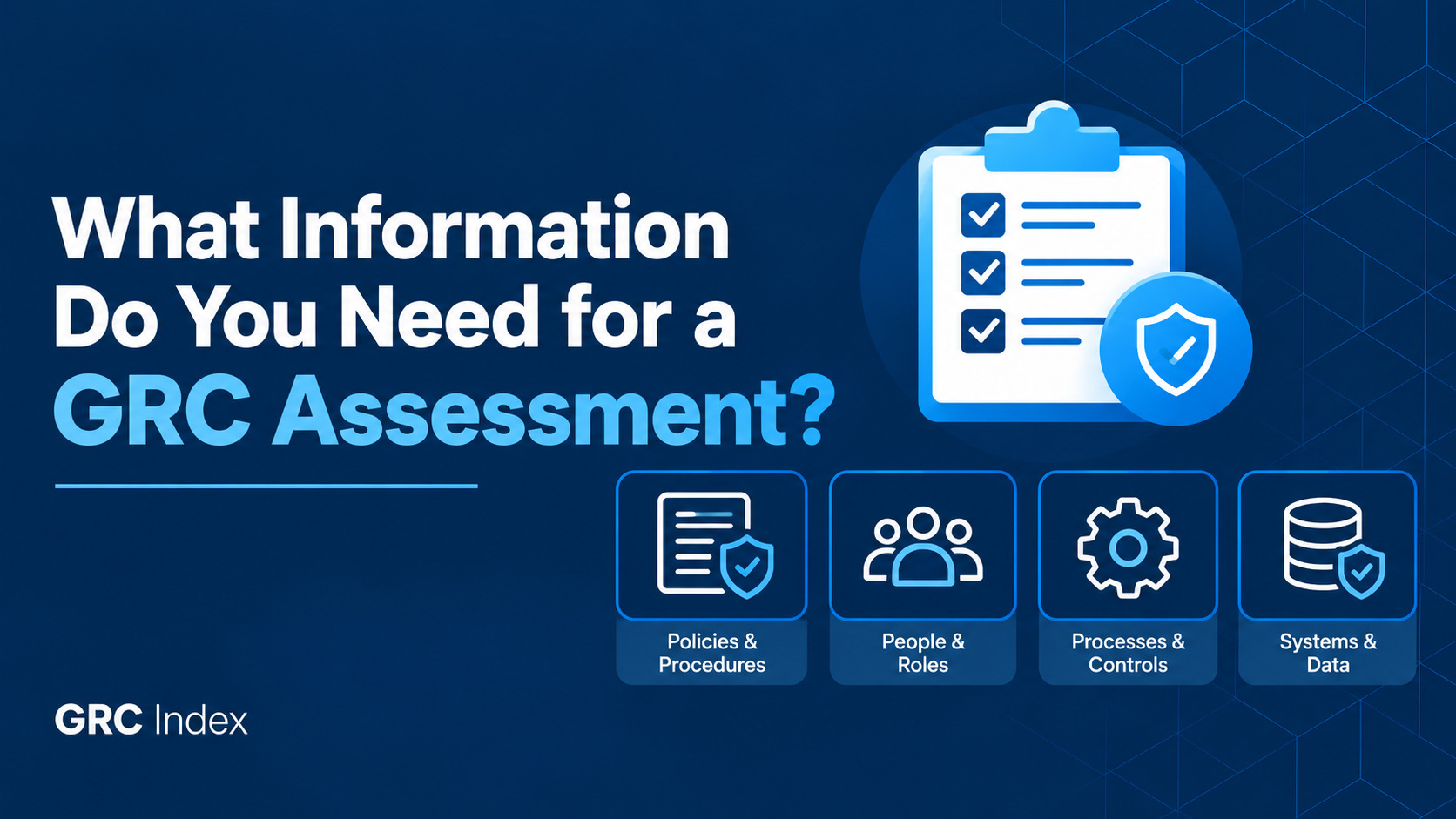
What Information Do You Need for a GRC Assessment?
To identify how risky an organisation is, a Governance, Risk, and Compliance (GRC) assessment needs to look at its corporate policies, risk registries, regulatory requirements, and proof of technical controls.
A GRC assessment puts your organisation under a clear, structured light. It tests governance, risk, & compliance practices against recognised international standards. Many organisations know they need one. Far fewer know what to bring.
You do not need to guess your way through the preparation. A structured GRC assessment covers five core domains, governance, risk management, compliance, resilience, and data security, each requiring specific evidence before a single score can be calculated. Prepare for all five, and you walk in ready. Ignore even one and gaps appear that slow the whole process down.
According to Forcepoint research, 71% of organisations admit they would fail a cyber or compliance audit if it happened today. The main reason is not weak controls. It is weak documentation and poor preparation.
There are 3 main points about GRC assessment.
- Governance Information
- Risk Information
- Compliance Information
What Governance Information Do You Need First?
Governance is the foundation of every GRC assessment. Assessors look at how your organisation makes decisions, who is accountable, and whether your policies hold up under scrutiny.
To start a basic governance structure, firstly, you need to be clear about the legal type of your organization, its purpose, key stakeholders, applicable laws, and the data or assets it is in charge of.
You need to gather your organisational chart, showing clear lines of authority from the board down to operational teams. Proper board meeting minutes from the past 12 months are important. They prove it’s active oversight, not just formal titles. You also need a documented policy library, covering areas such as access control, risk management, assessment procedures, roles and responsibilities and the purpose and scope of incident response & acceptable use.
Role and responsibility matrices matter here too. Assessors want to see that governance is not just written down. It must be assigned to named people. A GRC lead, security leadership, and project managers all carry defined responsibilities within a functioning governance structure. Without that clarity on paper, your governance score will reflect the gap.
Key governance documents to prepare:
- Organisational chart with board through to team level
- Board meeting minutes from the past 12 months
- Policy library covering access control, incident response, and risk management
- Role and responsibility matrices with named owners
- Corporate governance policy and ethical code of conduct
What Risk Data Do You Need to Bring to the Table?
GRC risk analysis starts with one question: does your organisation know what it is exposed to? Assessors test whether you have a working risk register, not just a theoretical one.
You need a current risk register that lists identified risks, their likelihood, their potential impact, and their assigned owners. Pair that with a written risk appetite statement, a document that defines how much risk your board formally accepts. Risk assessment involves evaluating identified risks for likelihood of occurrence and impact, using methods such as risk matrices and scenario analysis to understand criticality across financial, operational & reputational dimensions.
Incident history is equally important. Bring a log of past security incidents, near-misses, and how each one was handled. Add your IT asset inventory such as: (hardware, software, data, Infrastructure & Networks that the company relies on). Threat intelligence logs round this out, they show assessors that your risk function is active, not dormant.
Key risk documents to prepare:
- Current risk register with likelihood, impact, and risk owners.
- Risk appetite statement approved at board level.
- Incident history log with resolution notes for each event.
- IT asset inventory covering all systems, software, hardware, applications, and data stores.
- Threat intelligence logs showing active monitoring.
What Compliance Records Must You Have Ready?
Accordion to the research they shows that 71% of organisations admit they would fail a cyber or compliance audit if it happened today. The main reason is not weak controls. It is weak documentation.
To be ready for an audit, you need core governance, risk, & compliance (GRC) records accessible, updated and organized every time.
You need to identify every regulatory framework that applies to your organisation and map your controls to each one. GRC testing, the process of checking whether controls actually operate as designed, must be evidenced, not just asserted. Bring your audit trails, including logs of access, changes, and approvals across key systems.
Policy sign-off records prove that employees have read and acknowledged your policies. Evidence bundles, the actual documentation of control implementation, are what assessors test against. Without them, even a well-designed compliance programme looks like a plan, not a practice.
Key compliance records to prepare:
- Framework mapping document showing controls aligned to each applicable standard
- Audit trails covering access logs, change logs, and approval records
- Policy sign-off records with dated employee acknowledgements
- Evidence bundles per control showing implementation proof
- Regulatory obligation register listing all applicable laws and standards
What Do Assessors Need From Your IT and Security Environment?
Your IT environment carries a large share of any GRC assessment score. The assessors can tell that your technical controls are real, documented or regularly tested.
You need access control records that show who has access to what, and why. Role-based access reviews demonstrate that access is granted on a need-to-know basis and reviewed regularly. Bring your system inventory alongside patch management logs, these show that known vulnerabilities get addressed rather than left open.
Change management logs record every significant system change and the approval process behind it. Endpoint security configurations, encryption standards, and network architecture diagrams complete the picture. Vendor contracts and third-party risk assessments matter here too. Many compliance frameworks require third parties to adhere to regulatory requirements, and organisations must regularly confirm that vendors continue to comply.
What Happens If Your Information Is Incomplete?
Incomplete information does not end an assessment, it shapes the score. If your GRC information is incomplete or missing, the Gender Recognition Panel (GRP) will usually give formal instructions or ask/request about more information instead of giving you an immediate refusal.
The most common shortfalls are missing risk appetite statements, outdated risk registers, and policy libraries with no evidence of employee acknowledgement. IT asset inventories are often incomplete, and vendor contracts frequently lack compliance clauses. Each gap tells a story to an assessor about how seriously governance is treated day to day.
You can still progress an assessment with gaps if you present a clear remediation plan and a realistic timeline. Assessors expect imperfection, they do not expect organisations to pretend it does not exist. Honest, structured preparation matters far more than a polished facade with nothing behind it.
Does the Information You Need Change by Industry or Framework?
The major categories will stay the same. What changes is the depth and the specific evidence standard for each framework.
Under HIPAA, you need documented business associate agreements, patient data access logs, and breach notification procedures. Under GDPR, you need a data processing register, records of lawful bases for processing, and evidence of data subject rights procedures. ISO 27001 demands a full information security management system, an internal audit programme, and a Statement of Applicability. PCI DSS adds cardholder data flow diagrams, network segmentation evidence, and quarterly vulnerability scan reports.
Start with the framework most relevant to your sector. Map your location and your existing documents to its specific requirements first. You will quickly see which evidence you already hold and which needs to be created before your GRC assessment date.
How Do You Organise All This Information Before the Assessment Starts?
Before a GRC assessment, you need to organize your data. Becuase Assesement need Establishing visibility, Accountability and Centralized documentation. Managing a mountain of policies, spreadsheets, and evidence can feel overwhelming, but breaking it down systematically ensures you are audit-ready.
Assign ownership to each information category. Governance documents go to the compliance lead. Risk data goes to the risk officer. IT and security evidence goes to your CISO or IT manager. Set a collection deadline at least 3 weeks before your assessment date. That window gives you time to chase missing evidence and fix obvious gaps without rushing.
Some documents you need to prioritise that cover multiple frameworks at once. A well-written information security policy, for example, supports ISO 27001, SOC 2, and most regulatory frameworks simultaneously. Build from the common core outward to framework-specific requirements.
How GRCI Helps You Prepare and Score Your GRC Position
GRC Index (GRCI) is an independent, nonprofit benchmarking platform where organisations can assess, score, and publicly demonstrate their governance, risk, and compliance performance. The platform benchmarks against COSO, ISO 27001, SOC 2, and ISAE 3402.
You complete a structured questionnaire and submit documentary evidence across all five GRC domains. The expert reviewers and algorithmic scoring then evaluate your submission and produce a GRC Score, a single, verifiable number that tells you exactly where your organisation stands. Over 1,100 organisations have been indexed, and 86% achieve measurable improvement following their first assessment.
The assessment takes around 9 minutes to start and is free to complete. You receive a public GRC Index listing, a prioritised improvement roadmap, and a score you can share with customers, investors, and regulators.
GRCI covers five scored domains:
- Governance: Board oversight, policy framework, accountability structures, and strategic risk alignment
- Risk Management: Risk identification methodology, risk appetite statements, control testing, and risk reporting
- Compliance: Regulatory mapping, audit readiness, internal policy adherence, and third-party compliance evidence
- Resilience: Business continuity plans, incident response procedures, and disaster recovery testing
- Data Security: Information security controls aligned to ISO 27001, SOC 2 Trust Services Criteria, access controls, and encryption standards