
Search "GRC certification" and you'll get a wall of acronyms. CRISC. CISA. CISM. CGRC. Every result points you toward a personal exam, a study guide, and a fee schedule. But that's only half the picture.
Your company can also get certified. ISO 27001, SOC 2, PCI DSS, these are not things a person passes. They're things an organization earns. And if you're trying to figure out which kind of GRC certification your situation actually calls for, mixing up these two tracks wastes your time and your budget.
This guide splits the two apart. You'll see what companies get certified for, what individuals get certified for, and how to tell which one solves your actual problem.
What Does GRC Certification Actually Mean?
GRC stands for governance, risk, and compliance. It's the discipline that keeps an organization's decisions, controls & regulatory obligations working together instead of pulling in different directions.
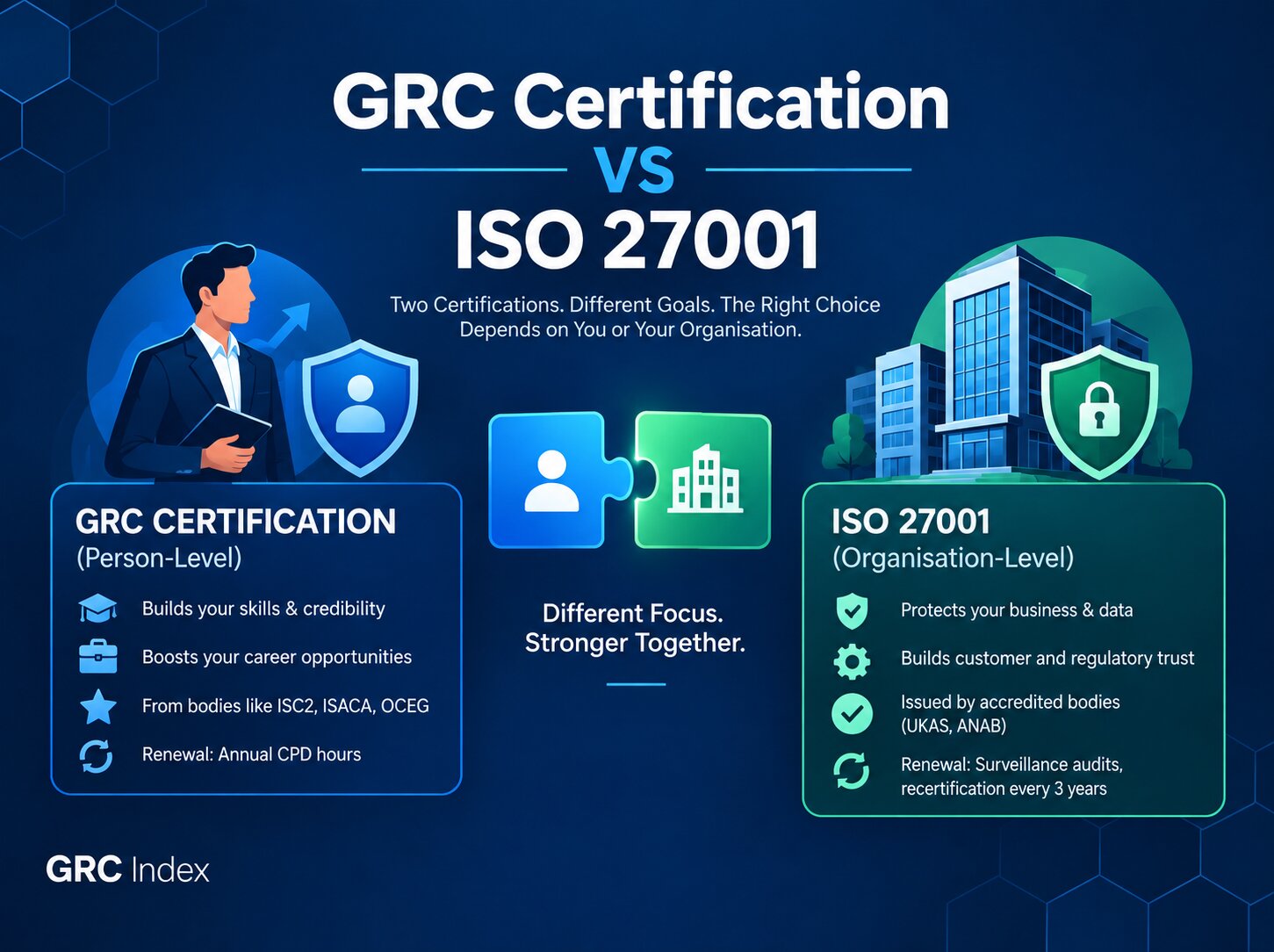
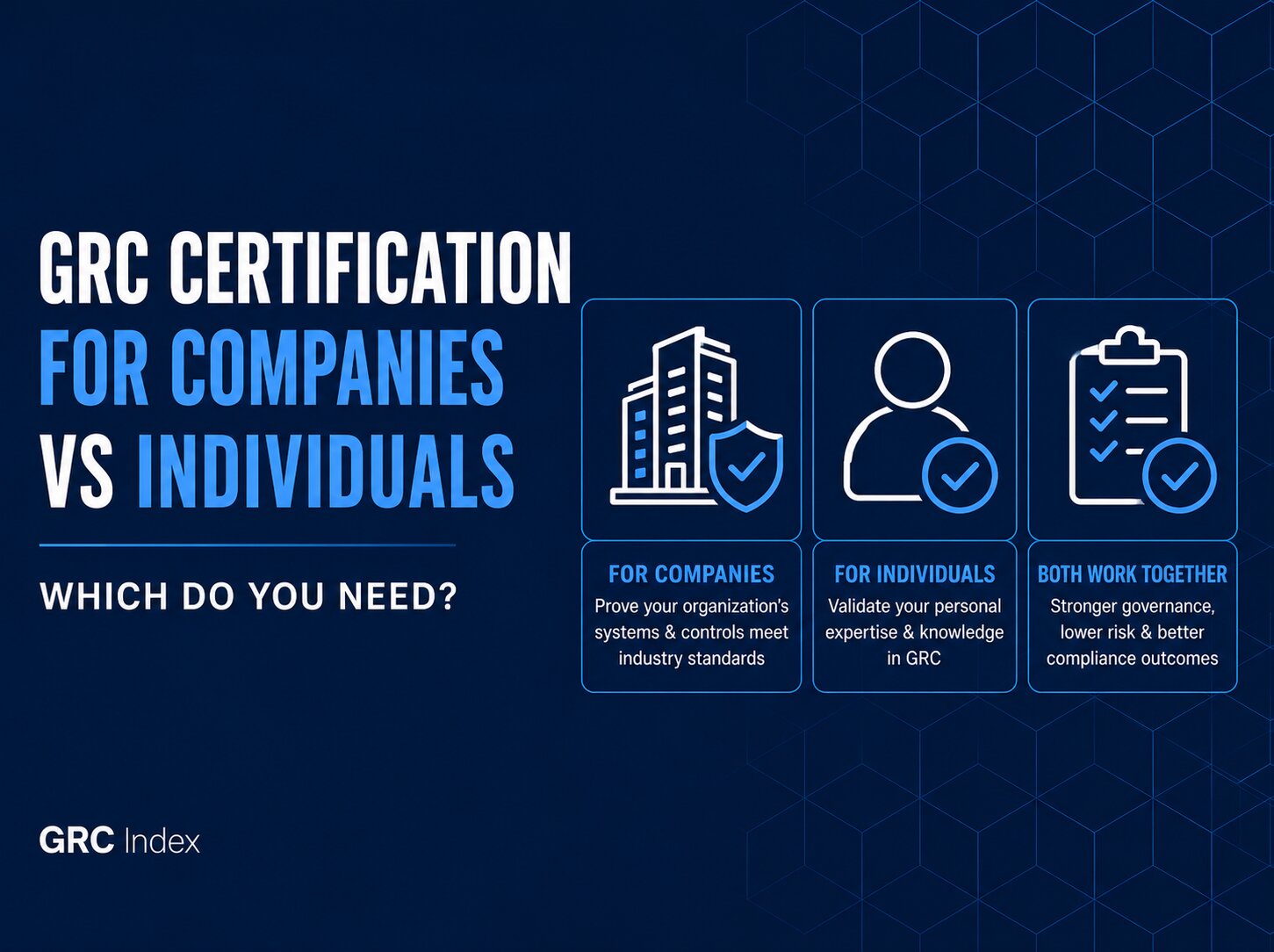
"GRC certification" splits into two completely different products under one label. The first type certifies an organization. An auditor checks your company's controls against a standard, and if you pass, your company holds the certification. The second type certifies a person. You sit an exam, prove your knowledge of risk or compliance concepts, and you personally hold the credential.
GRC Certification for Companies: What Gets Certified?
Company-level GRC certification checks your organization's actual practices, not any one person's knowledge. An external auditor examines your policies, your controls, and your evidence, then issues a certificate or report in your company's name.
These are the security compliance certifications that show up on vendor questionnaires, procurement checklists, and enterprise sales calls. Losing a deal because you can't produce one of these is common — and expensive.
ISO 27001. The global standard for information security management systems, published and maintained by ISO. It covers how you identify risks, apply controls, and keep improving your security posture over time. Enterprise buyers in Europe and Asia often treat it as a baseline requirement.
SOC 2. An American Institute of CPAs framework built around five Trust Services Criteria: security, availability, processing integrity, confidentiality, and privacy. SaaS companies selling into the US market lean on this one heavily.
PCI DSS. Mandatory if you store, process, or transmit payment card data. The Payment Card Industry Data Security Standard sets specific technical controls around cardholder data, and non-compliance can mean fines or loss of card processing privileges.
UK GDPR. The UK's own version of the EU regulation, running separately since Brexit and enforced by the ICO. It doesn't issue a single "certificate" the way ISO does, but it requires a documented compliance programme, and any UK company handling personal data needs to show one on request.
Cyber Essentials and Cyber Essentials Plus. Backed by the National Cyber Security Centre, this is the certification UK buyers actually expect to see first. Government contracts often require it outright, and a growing number of private-sector procurement teams ask for it before ISO 27001 even comes up. Cyber Essentials Plus adds an independent technical audit on top of the base self-assessment.
ISAE 3402. An international assurance standard for controls at service organisations, and one UK companies lean on more than SOC 2, since it's the framework used across the UK and Europe rather than a US-specific one. It sits alongside ISO 27001 and COSO as one of the core standards the GRC Index benchmarks against.
ISO 42001. The newest addition to the list, built specifically for AI management systems. As AI governance regulation accelerates, expect this one to show up in more vendor questionnaires over the next two years.
You should treat organizational certification as proof your company's systems, not your headcount, meet a defined bar. A candidate can't hand a client an ISO 27001 certificate. Your company can.
Benchmarking your organization against these standards before you commit to a full audit is worth doing early. Tools like the GRC Index let you score your current governance, risk, and compliance maturity against COSO, ISO 27001, and SOC 2 criteria, so you know where the real gaps sit before an auditor finds them for you.
12 GRC Certifications Worth Knowing
Before you go deep on the individual-track certifications, here's the full landscape in one place. These are the credentials that consistently show up in GRC and security compliance job postings.
- CRISC — Certified in Risk and Information Systems Control, issued by ISACA
- CISA — Certified Information Systems Auditor, issued by ISACA
- CISM — Certified Information Security Manager, issued by ISACA
- CGEIT — Certified in the Governance of Enterprise IT, issued by ISACA
- CGRC — Certified in Governance, Risk and Compliance, issued by ISC2
- CISSP — Certified Information Systems Security Professional, issued by ISC2
- GRCP — GRC Professional, issued by OCEG
- CRMA — Certification in Risk Management Assurance, issued by the IIA
- PMI-RMP — Risk Management Professional, issued by the Project Management Institute
- CCEP — Certified Compliance and Ethics Professional, issued by the Compliance Certification Board
- CIPP/E — Certified Information Privacy Professional/Europe, issued by IAPP
- ISO 27001 Lead Implementer — issued by accredited bodies such as PECB and BSI
Twelve credentials, four different issuing bodies, and no single "best" answer. The right one is totally depends on which part of GRC your job actually touches: risk, audit, security management, or compliance program design.
GRC Certification for Individuals: What Gets Certified?
If you want GRC certification as an individual before applying, you need to prepare these things. You need to study before the exam, you sit the exam, and the credential follows your career, not your employer. Here's a closer look at the six credentials that come up most often.
CRISC (Certified in Risk and Information Systems Control). Issued by ISACA and built for professionals who manage IT risk at scale. You need 3 years of cumulative experience across at least two of four risk domains. In the exam, there are 150 questions, and the fee sits around $575 it around (£450–£550) for members or for non-members it’s $760 (£600–£600+).
CISA (Certified Information Systems Auditor). Also from ISACA, this is the standard credential for IT audit and assurance work. Five years of relevant experience gets you eligible, though education and other certifications can offset part of that requirement. Over 170,000 professionals hold this one worldwide, which tells you how deep its recognition runs.
CISM (Certified Information Security Manager). ISACA's management-track credential, built for those people who run security programs rather than just execute controls. Five years of information security management experience is the baseline, with at least three of those years in a management capacity.
CGRC (Certified in Governance, Risk and Compliance). Formerly known as CAP, this ISC2 credential focuses on authorizing and maintaining information systems within formal risk frameworks. It carries particular weight in government, defense, and federal contracting circles, where NIST's Risk Management Framework is the daily reality.
CCEP (Certified Compliance and Ethics Professional). CCEP is issued by the Compliance Certification Board, this one skews toward the compliance-officer side of GRC rather than the IT-security side. 1 year of compliance experience qualifies you to sit the exam, making it more accessible than the ISACA credentials.
GRCP (GRC Professional). OCEG's entry point into formal GRC certification, and the most open of the group. There is no experience requirement, no prerequisite, just a 100-question exam you have two hours to complete. Anyone early in a governance, risk, or compliance career can start here, then layer a more specialized credential on top later. OCEG's own training and certification programs are worth reviewing if you're mapping out which credential fits your current role before you commit study time to one.
Every one of these six proves individual competence. None of them says anything about whether your company's actual systems are secure or compliant. That gap is exactly why the two certification tracks exist separately in the first place.
Company Certification vs Individual Certification: Where They Actually Differ
Side by side, the differences are sharper than they first appear.
A company can hold an ISO 27001 certificate with zero individually certified staff on the payroll, as long as an outside consultant or auditor built the program. And a person can hold a CRISC credential while working at a company with no formal certification at all. The two tracks run in parallel, not in sequence.
Does Your Company Need a GRC Certification?
Ask yourself one question first. Is a customer, regulator, or partner actually blocking you until you produce proof?
That's usually how the need shows up in practice. A prospect's security team sends a vendor questionnaire, and half the questions assume you already hold SOC 2 or ISO 27001. A healthcare partner won't sign until you can show HIPAA compliance documentation. A payment processor requires PCI DSS before you can go live.
You should pursue organizational certification when your company handles sensitive customer data at scale, when company deals are stalling on security review, or when a specific regulation legally requires it, such as PCI DSS for payment handling. Smaller B2C businesses with minimal data exposure often don't need this yet, and getting it early just burns budget you don't have to spend.
A useful gut check: run your organization through a free maturity benchmark before you commit to a full audit. The GRC Index assessment scores you against governance, risk, compliance, resilience, and data-security criteria in under ten minutes, and it tells you whether you're audit-ready or still months away.
Does Your Team Need Certified GRC Professionals?
Flip the question around. Do you need someone on staff who can build and run the program, not just a piece of paper proving the company passed an audit?
If you're standing up a GRC function from nothing, someone needs to know how to write the risk register, map controls to a framework, and prepare evidence for the auditor. That's exactly what individual certifications like CRISC & CISA train people to do. Hiring managers list these credentials in job postings precisely because they signal a candidate already knows the methodology, not just the theory.
You should prioritize certified individuals when you're building an internal GRC or security team, when you need someone leading audit prep and control testing, or when a role explicitly requires it for compliance with a contract or regulation. A one-person startup outsourcing its compliance work to a consultant probably doesn't need to hire a CISA-certified auditor just yet.
Can You Need Both? (Usually, Yes)
Most mature GRC programs run both tracks at the same time, and that's not a coincidence.
Your company pursues ISO 27001 or SOC 2 because customers demand proof at the organizational level. Meanwhile, the person managing that program internally holds a CRISC or CISA credential, because someone has to actually design the risk assessments and keep the evidence audit-ready year over year. The individual certification builds the capability. The company certification is the output that capability produces.
Growing SaaS companies like (Sage, Snyk, Darktrace & Wise) are the clearest examples. Most of these companies hire a compliance lead who already holds CISA or CRISC certifications, and that hire is exactly what gets the company through its first SOC 2 audit smoothly instead of scrambling for six months. The credential and the certificate reinforce each other.
How to Choose the Right Path for Your Situation?
Run through this checklist before you commit money or study time to either track.
- If your customers, your investors, or regulators are asking for proof at the company level? Then you should start with organizational certification.
- Are you personally trying to move into or up within a GRC, risk, or audit career? Then you should start with an individual credential.
- Is your company building an in-house GRC function for the first time? Hire or train toward CRISC, CISA, or GRCP first, then pursue the company certification once someone can own the process.
- Is a specific deal or contract blocked right now on a missing certification? Identify exactly which standard the blocker requires, ISO 27001, SOC 2, or PCI DSS, then scope that audit directly instead of guessing.
- Are you unsure where your organization actually stands today? Run a benchmark assessment before spending on a formal audit, so you know your real gaps first.
GRC certification is not only one decision. It's two separate ones, and mostly growing companies end up making both. Know which problem you're actually solving before you write the check or block out study hours, and you'll spend your budget on the credential that actually moves your business or your career forward.
FAQs
What is the best certification for compliance?
The Certified Compliance & Professional (CCEP) certification is frequently seen as the best general compliance certification for compliance officer roles across all industries. The best credential for you will depend on your industry and area of expertise, since different fields need different kinds of regulatory knowledge.
Is GRCP certification worth IT?
If you want an affordable introduction to GRC, the GRCP (Governance, Risk, and Compliance Professional) certification is worth getting. However, it is not as well known in the job market as more prestigious auditing or security qualifications. The exam, which is given by OCEG, it checks how much knowledge you have of core business rules and systems.
Which is better, CRISC or CGRC?
It is not clear which one is better: The Certified in Risk and Information Systems Control (CRISC) or the Certified in Governance, Risk and Compliance (CGRC ). It's totaly depend on your career or job goal.
.jpg)